
The Dagger
A person must practice an art to perfect it.
Reflected Light
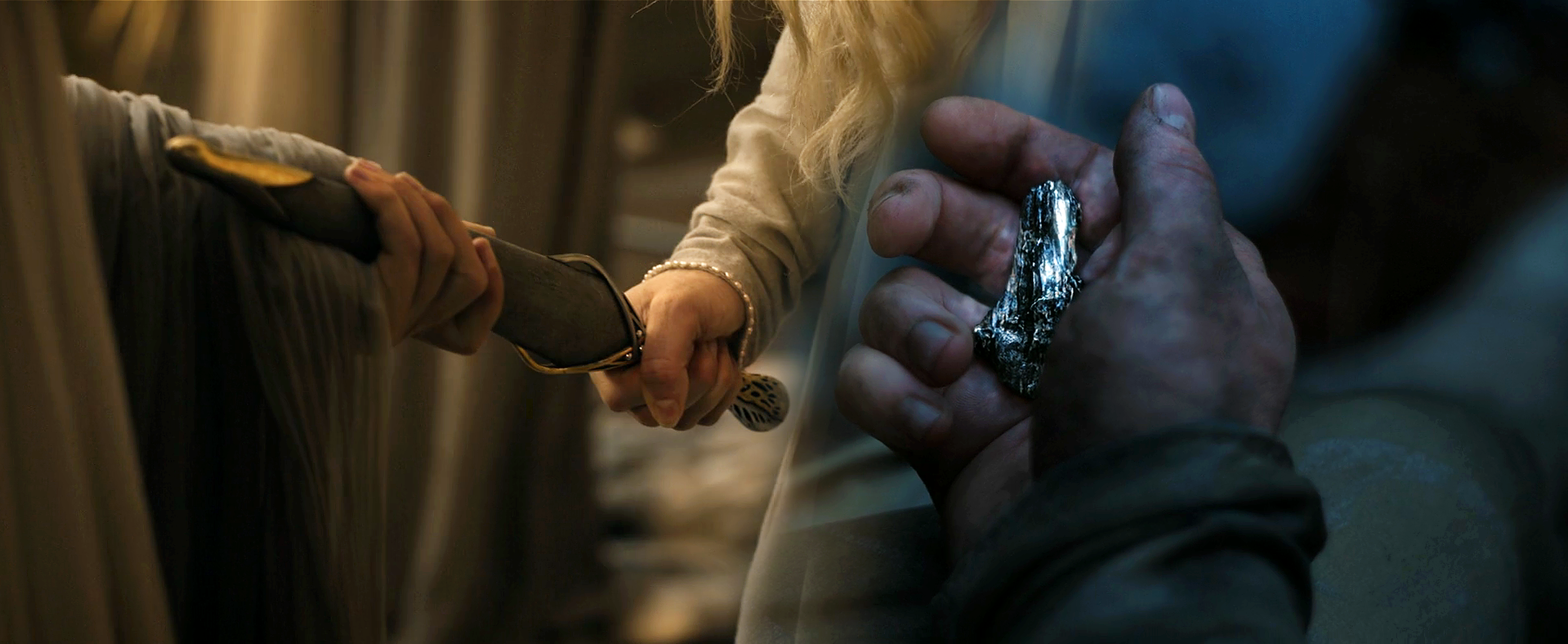
The dagger was always valuable in more ways than one. It was made of the most exquisite quality of gold and silver, and having belonged to Galadriel’s closest brother, it held a lot of sentimental value. But the same template we used for mithril can be applied to the dagger. In the boat scene, all focus was on the dagger as we heard Galadriel say, for the second time:
“But sometimes, the lights shine just as brightly reflected in the water as they do in the sky” (1×01).
Reminding us of that metaphor in this way seemed like a warning, the same as Elrond saying that mithril almost seemed lit from within. The dagger was not always strange, at least when we first saw it to establish the connection with Finrod. But it eventually became a burden.
“…at the rear went Finarfin and Finrod, and many of the noblest and wisest of the Noldor; […] Mor than any others of the Exiles they carried thence memories of the bliss they had forsaken, and some even of the things that they had made there they took with them; a solace and a burden on the road.”
Of the Flight of the Noldor
“Do not take the burden of this day upon your shoulders, Theo. You may find it difficult to put it down again” (Galadriel, 1×07).
Perilous Path
After Finrod’s death, matters were strange. The way Galadriel took the dagger was the first anomaly.
“And there, in the darkness, his vow became mine” (Galadriel, 1×01).

We heard no perilous whisperings, but there were more subtle ways that signified Sauron tampered with the dagger as he did with mithril. Focus was on the dagger when she said “his vow,” which to the viewer subconsciously registers as: “His dagger became mine.”* It seemed to have a similar effect on Galadriel as the One Ring had on Frodo, albeit less intensely.
* The One Ring was called mine 9 times in The Lord of the Rings.
Finrod’s body had been retrieved from the place Sauron imprisoned him, so in no world can we assume that Sauron never touched the dagger. It was around that time in the First Age that Sauron was described as:
“…a sorcerer of dreadful power, master of shadows and of phantoms, foul in wisdom, cruel in strength, misshaping what he touched, twisting what he ruled.”
Of the Ruin of Beleriand and the Fall of Fingolfin
It was therefore significant that Sauron never touched the Three Elven Rings. Otherwise, they would have been corrupt, although they were still subject to the One Ring. If Sauron touched the dagger, it would be corrupt. He did possess it in episodes 2 and 3, but the effect on Galadriel could be seen long before she ever met him. The dagger began as a symbol of her relationship with her brother, and it eventually came to symbolize her obsession with finding Sauron, which, as Patrick McKay said, character after character told her was not a good thing.
Claiming possession of the dagger marked the very beginning of her obsession, a few thousand years before she was in Forodwaith. The obsession seemed to have been driven by the dagger, or it was at least directly associated. Many moments* point to this, but the most significant is the whole boat scene (see Galadriel’s Obsession Part 4).
* Some listed here.
Sauron himself confronted Galadriel about her obsession, in Númenor.

He asked his questions in a significant order (see Galadriel’s Obsession Part 2 and Part 3):
“What do you know of darkness?”
Galadriel took up the dagger “in the darkness.” Sauron immediately asked about it with no need for an answer to his first question.
“Whose dagger was it, Galadriel?”
The whole interrogation led to this question:
“Why do you keep fighting?”
This suggests that Sauron already knew about the dagger and its relation to Galadriel’s obsession. He knew what happened to Finrod—he was responsible for it. He knew that Galadriel took the dagger (and a vow) in the darkness and hunted him for centuries. He already knew, as she confessed, that she was not vengeful. These were rhetorical questions. He tried to bring Galadriel to a realization, but he pushed too hard and was startled by his own reflection.
Sauron: “Why do you keep fighting?”
Galadriel: “Because I cannot stop!” (1×05).

What did he want her to know? —The same things he told her in the vision. He pushed her too hard in Númenor, but in Eregion, having learned that using too much force is not the way to go, he decided to calmly give her the answers to each of his questions.
- Whose dagger was it, Galadriel? —“My old dagger.”
- What do you know of darkness? —“You’ve kept it safe all this time.”
- What happened to [Finrod]? —“I learned that [to ensure peace] was Sauron’s task, as well.” (He was killed in a place of darkness and despair by servants of Sauron.)
- Oh, so this is about vengeance? —“No, Galadriel. [Sauron] was seeking a power. […] You told me once that we were brought together for a purpose.”
- Then what is it? —“This is it.”

- Why do you keep fighting? —“You have been very brave. And you have fought so hard for so many years to complete the task that I could not. […] My task was to ensure peace.”
- You’re asking me to go to the one place that I swore never to return. The least you can do is tell me why. —“Together, we can save this Middle-earth.”
“Save, or rule?”
“I see no difference.”
“And that is why I will never be at your side.” - Why do you keep fighting? —“You have no choice.”
(“Because I cannot stop!”)*
* Disclaimer: Galadriel did have a choice. Sauron just tried to make her feel like she did not.
The dagger having a similar effect as the One Ring (attachment, obsession, turning strengths into weaknesses) would explain why the Rings Theme played twice in reference to Galadriel’s obsession, and once over the dagger itself. Here is the Rings Theme, for reference:
- Galadriel said she could not stop, after a conversation involving the dagger.
- She told Theo that the eruption of Orodruin was her fault because of her obsession. Theo had just attempted to take the dagger.
- She emerged from the water with the dagger in her hand.
So, her obsession was not a good thing. Patrick McKay suggested that Sauron may have been calling Galadriel to him. By what means could he do this?
The dagger.
“These Rings have a way of being found. In evil hands it might have done great evil. Worst of all, it might have fallen into the hands of the Enemy. Indeed it certainly would; for this is the One, and he is exerting all his power to find it or draw it to himself.“
Gandalf, The Lord of the Rings: The Shadow of the Past
That means he not only wanted to find Galadriel, but he wanted the dagger itself. Why?
The Power
(Some perspectives on this subject have been slightly altered from what I said in Sauron: The Perfect Inverse of Beren.)
We have bits of knowledge with which we can fill some blanks in The Silmarillion. Sauron’s search for the power to heal Middle-earth fueled his motivation at the time of Finrod’s death. We can infer that Finrod had the dagger on his person when he and Beren were captured, and when he fought Sauron with songs of power. After he lost, the whole company was stripped of their disguises, and presumably their possessions—including the dagger.
Driven by this pursuit of a power over flesh, Sauron would never overlook something made of the purest gold and silver. He could use it. It may also have been one thing that helped him perceive Finrod to be a “Noldo of great might and wisdom,” when he could not discover his identity or task. He also knew that “in him lay the secret of their errand.” What other secrets could Finrod have hidden?
Sauron purposed to keep Finrod alive longer than the rest of the company, but Finrod sacrificed his life to protect Beren.

In that hour, “Sauron stood in the high tower, wrapped in his black thought.”
Sauron’s plans were not entirely foiled. He never discovered who Finrod was or why he was passing through Taur-nu-Fuin, but he may have discovered some secret. How would Finrod “learn” that Sauron’s task was “to ensure peace?” Sauron would not have simply told all of his secrets* to him. Sauron essentially told Galadriel, “No, Finrod didn’t die because of me. I was just seeking a power to heal things.” This hauntingly suggests that Finrod was involved in early experiments. He learned the hard way.
Galadriel only saw the mark twice: on the anvil (which we theorized was directly associated with mithril) and on Finrod. Someone on Twitter/X (I cannot remember who) observed that amidst the chaotic noises when Sauron’s mark burst into flames, we could hear Finrod’s voice. The same clip was shown on The Late Show with Stephen Colbert, but Finrod’s voice is louder. It is distinctly him yelling, “Firuvantë*!” from the prologue.
* Sauron’s search for a power to heal Middle-earth would have been a closely-kept secret because he was still a servant of Morgoth, who wanted everything destroyed.
* Fir- -uva -ntë — “They will die.”
In Forodwaith, Sauron channeled a very large portion of his power in mithril; but long before that, in the beginning stages of his efforts, he may have harnessed a much smaller portion in the dagger. It would be a slightly different power than that in mithril; darker. But it would still be his.
The power within mithril is different from the One Ring. One is meant to heal, and the other is meant to dominate. When Sauron experimented with mithril at the beginning of the Second Age, he still had fair motives. He did want to rehabilitate Middle-earth. The power would be beneficial, but it would become proud as Sauron’s lust and pride increased.
“The mithril is proud. It refuses every effort to bond it with lesser ores” (Celebrimbor, 1×08).
Once Sauron became fixed on his own dominion, he would determine to use a power that could control others’ minds and wills. He would use a different material for this—one that would compliment such a dark power. It was that power which was later harnessed in pure gold, in the form of the One Ring. Morgoth’s power was disseminated throughout all of the gold in Arda, maybe including gold from Valinor, if only to a lesser degree than Middle-earth. Of course, even if gold from Valinor was not damaged by Morgoth (although he undid a lot of the works of Aulë), all things can be poisoned or defiled, even if they originate from Valinor.
Sauron found the power to heal Middle-earth, and lost his chance to craft it when Huan defeated him right after Finrod died. But he had already crafted a power to rule in the form of a sword hilt in the First Age (the key to unlock a dam which would flood Orodruin and trigger its eruption).

“It speaks not only of a place, but a plan. A plan by which to create a realm of their own where evil would not only endure, but thrive. A plan to be enacted in the event of Morgoth’s defeat, by his successor” (Galadriel, 1×03). —Galadriel was reading the plan to create Mordor.
“But do you know what it is? It is no sword. It is a power fashioned for our ancestors by his master’s own hand” (Waldreg, 1×04).
“It is a key, conjured by some forgotten craft of the Enemy to enslave your ancestors” (Arondir, 1×05).
“Only blood can bind” (Adar, 1×05).

As far as we know, the hilt only had the power to bind, not the power to influence minds and wills. It was incomplete. To perfect the particular craft that would later create a Ruling Ring, Sauron would need more practice. The dagger, being partially made of gold may have been the next step in perfecting it.
“It was this Morgoth-element in matter, indeed, which was a prerequisite for such ‘magic’ and other evils as Sauron practised with it and upon it.”
Morgoth’s Ring: Part Five: Myths Transformed
As Gandalf said: “These Rings have a way of being found. […] this is the One, and [Sauron] is exerting all his power to find it or draw it to himself.” Adar would know if the dagger contained a power that allowed Sauron to draw it to himself. He was there. Galadriel’s determination to find Sauron would prove to him that it worked. And he laughed.
This presents an interesting pattern. A particular deposit of mithril contained Sauron’s power designed to save Middle-earth, and a particular portion of gold (the dagger, and later the One Ring) contained his power designed to rule. Together, according to Sauron, they could save Middle-earth.
Galadriel: “Save, or rule?”
Sauron: “I see no difference” (1×08).
The elements would compliment their respective purposes, mithril being less corrupt than gold. This mithril and the gold (and silver) from Galadriel’s dagger made the Three Elven Rings, which Sauron never touched. But portions of his power being contained within the elements that made them (as well as him touching them early in the season) explains exactly why they were still subject to the One Ring.
It also explains the Eye in the combination.
