
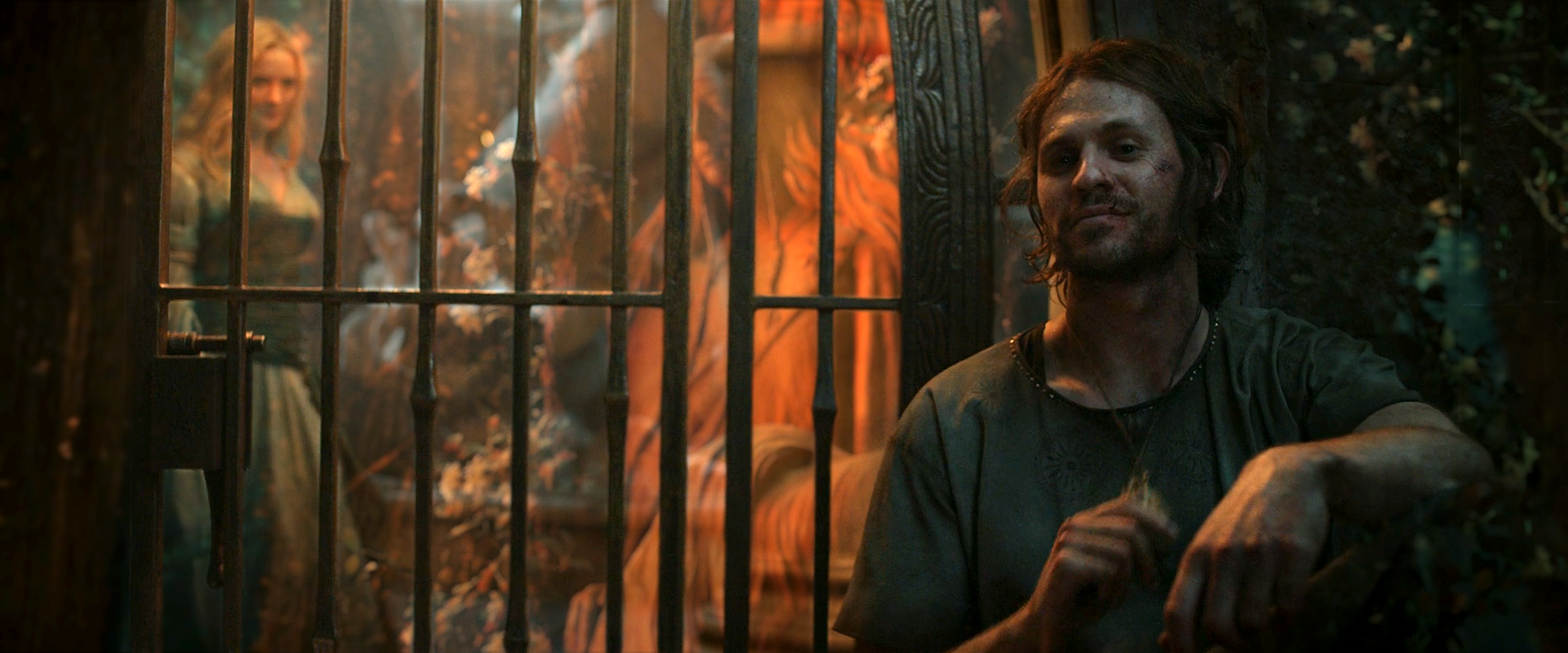

Part 2: THE KEY
Most of the parallels henceforth (rather than being near-exact copies) are perfect inverses, like night and day, land and sea, love and lust, and even the differences in hair color and clothing between Galadriel and Lúthien. Everything is upside-down.
¶ 4: Reverie
It is told in the Lay of Leithian that Beren came stumbling into Doriath grey and bowed as with many years of woe, so great had been the torment of the road. But wandering in the summer in the woods of Neldoreth he came upon Lúthien, daughter of Thingol and Melian, at a time of evening under moonrise, as she danced upon the unfading grass in the glades beside Esgalduin. Then all memory of his pain departed from him, and he fell into an enchantment; for Lúthien was the most beautiful of all the Children of Ilúvatar. Blue was her raiment as the unclouded heaven, but her eyes were grey as the starlit evening; her mantle was sewn with golden flowers, but her hair was dark as the shadows of twilight. As the light upon the leaves of trees, as the voice of clear waters, as the stars above the mists of the world, such was her glory and her loveliness; and in her face was a shining light.
If “stumbling into Doriath” means “stumbling into Númenor” for Sauron, it may seem that the events following are chronological. However, context does not allow Part 2 to begin at the meeting on the raft. For all we know, the beat between “stumbling into Doriath” and “wandering in the summer” could represent a massive, reverse time jump; or perhaps Sauron’s stumble into Númenor is yet another echo of a centuries-prior circumstance.
That is why Sauron’s backstory has two branches. Part 1 had everything to do with all living things and mithril, and began around the time of Adar’s betrayal. Part 2 will view his motives from the other, equally important half: Galadriel and the dagger, which begins just before Finrod’s death.
But wandering in the summer in the woods of Neldoreth he came upon Lúthien, daughter of Thingol and Melian, at a time of evening under moonrise, as she danced upon the unfading grass in the glades beside Esgalduin.
Beren happened upon Lúthien long before they formally met. Likewise, Sauron would be aware of Galadriel’s existence before the raft.
When did he first become aware of her? —There is reason to believe that we witnessed the exact moment.
Sauron was always active in times of hiding. As previously determined, he sought a power to heal Middle-earth before Finrod died, went missing after Huan incapacitated him, then returned to craft that power in Forodwaith after Morgoth fell. He went missing yet again after Adar betrayed him, then returned to obtain the requirement for his craft. By the end of season 1, he had obtained the proper knowledge and skill to craft his desired power.
In short, each development (seek, craft, obtain) implies that despite Sauron’s obstacles, he increased in knowledge and skill instead of staring at the corner of a wall. One of the strongest indications of this was in the first episode. Who was correct: Thondir or Galadriel?
Thondir: “The mark is centuries old. Whoever left it could be long dead.”
Galadriel: “Or lying in wait, gathering strength, perfecting whatever dark art eluded him here” (1×01).
It is dangerous to become complacent, so let us heed her suggestion that though Sauron was missing, he was still “perfecting whatever dark art eluded him” in Forodwaith. As has been said from the beginning, the process of perfecting an art entails practice, and Sauron’s art was of the unseen world. Before he would be able to create anything on the level of a Ruling Ring, he would be under the necessity of practicing such sorcery. How?
One thing by which he would have practiced is: mithril (Part 1). Now (in Part 2), we will look at the first object he would have used: the dagger.

What made the dagger so odd?
In no world can we assume Sauron never touched it. From the series alone, we know that Finrod’s body came from Sauron’s dwelling. Not only was Sauron responsible for Finrod’s death, but he marked Finrod’s flesh with the same mark that was seared on the anvil in Dúrnost—the location we associated with mithril.

Again, Sauron was seeking a power to heal Middle-earth when Finrod died, which allows us to fill in some blanks.
It is implied that Sauron’s search for that power fueled his motivation at the time. When we read The Silmarillion, we can infer that when Finrod and Beren were captured, Finrod was in possession of his dagger. After Sauron defeated him in a contest of songs of power, the whole company was stripped of their disguise, and their possessions were presumably confiscated. Sauron, driven by his pursuit of a power over flesh, would never overlook a dagger made of gold and silver from Valinor, especially one that belonged to “a Noldo of great might and wisdom,” as he perceived Finrod to be. He could not discover Finrod’s identity, but he “deemed that in him lay the secret of their errand,” and purposed to keep him alive longer than the rest of the company. But when Finrod sacrificed his own life for Beren, fulfilling his oath, Sauron’s designs were foiled.
What would he do?
All we know, from the book, is that in the hour of Finrod’s death, Sauron stood in the high tower, wrapped in his black thought. Can we not safely assume that Sauron’s black thought had everything to do with Finrod and his dagger? If they had absolutely nothing to do with Sauron’s search for a power of the unseen world, why would he himself directly make the connection?
Sauron as Finrod: “My old dagger. You’ve kept it safe all this time.” […]
Galadriel: “No, you died. Along with countless others because of him.”
Sauron as Finrod: “No, Galadriel. He was seeking a power. Not to destroy Middle-earth, but to heal it” (1×08).
Fast forward to Galadriel’s possession of the dagger. It is assumed that she only cleaved to it because it once belonged to her closest brother, but this is only partially true. There are many blaring, yet subtle, indications that point to a more peculiar attachment. And not just any peculiar attachment—the dagger had a similar effect on Galadriel as the One Ring had on Frodo.
Whoever possessed the Ring would cherish it to the point of obsession. It was called “mine” at least nine times in The Lord of the Rings (excluding “ours” or “my own”) by Frodo, Bilbo, Gollum, and even Boromir. When Galadriel took possession of the dagger, she said:
“And there, in the darkness, his vow became mine” (1×01).

(The camera was only on the dagger when she said “his vow.” This subconsciously registers as: “His dagger became mine.”)
This moment marked the very beginning of Galadriel’s obsession,* long before the defeat of Morgoth and a few thousand years before she was in Forodwaith.
* “Is her obsession, which character after character in the show tells her is not a good thing… Is [Sauron] calling her to him?” (Patrick McKay).
Whenever the show alluded to Galadriel’s obsession, visuals and/or dialogue drew special attention to the dagger. The above instance was the first; here are more examples:
“More and more of our kind began to believe that Sauron was but a memory, and the threat at last was ended. I wish I could be one of them” (Galadriel, 1×01).

“I have been searching for my peace for longer than you know. Please, for both our sakes, let me keep it. Perhaps some peace could do you good, as well” (Sauron, 1×03).

Sauron: “What do you know of darkness? Whose dagger was it, Galadriel? Who is it you lost? […] Why do you keep fighting?“
Galadriel: “Because I cannot stop!” (1×05).

(The Rings Theme ominously plays right after Galadriel says she cannot stop fighting.)
Sauron: “If I could just hold onto that feeling, keep it with me always, bind it to my very being, then I…”
Galadriel: “I felt it, too” (1×06).
Opening shot of the scene:

Theo: “What are you so bothered about? It isn’t your fault.”
Galadriel: “Yes, it is” (1×07).

(The Rings Theme plays again after Galadriel says it’s her fault that the creation of Mordor was not prevented.)
“You told me once that we were brought together for a purpose. This is it” (Sauron, 1×08).

(I did not include the time Galadriel said, “I have pursued this foe since before the first sunrise bloodied the sky,” because that is not a reference to her specific obsession with finding Sauron. She was not obsessed before the first sunrise, but rather set out from Valinor with the rest of the Noldor who followed Fëanor, to pursue Morgoth and the general Enemy. Her specific obsession with hunting Sauron began centuries after the first sunrise.)
In Forodwaith, Sauron may have channeled a large portion of his power in mithril. Now we hypothesize that long before mithril, in the beginning stages of his efforts, he harnessed another, much smaller portion in the dagger. These happen to be the two items which were combined to create the Three Elven Rings. Sauron’s power being contained within the two things that made the Three Rings explains how they are still subject to the One Ring, notwithstanding Sauron never touched the Three themselves.
“Three remained unsullied, for they were forged by Celebrimbor alone, and the hand of Sauron had never touched them; yet they also were subject to the One.”
Of the Rings of Power and the Third Age
Sauron “sees” Galadriel, according to J.D. Payne, so when was the moment he first “saw” her?
(The following theory was conjured after months of weighing two possibilities.)
First, Sauron did not specifically target Galadriel at first. This means he did not leave the dagger on Finrod’s body for her to find;* he most likely left it as a tab into the Elven race, after he deemed Finrod to be an effective opening. He did not know that Finrod’s sister would be the one to take it, but once she claimed it for her own, she was his target.
* The mark is also very important, as was the mark on the anvil where Sauron tampered with mithril.
The simple act of Galadriel taking the dagger had no greater significance than Frodo placing the Ring on his finger; at least, the act alone had little impact. However, two unique occasions included a declaration of possession. If Sauron actively sought for the dagger, as he did the Ring, Galadriel claiming it for her own may have instantly brought his attention to her, as was the case when Frodo claimed the Ring in Mount Doom.
The beginning of Galadriel’s obsession would be the exact moment Sauron “saw” her:
“And far away, as Frodo put on the Ring and claimed it for his own, […] The Dark Lord was suddenly aware of him, and his Eye piercing all shadows looked across the plain to the door that he had made.”
The Lord of the Rings: Mount Doom
The irony is that when Sauron perceived Frodo, “the magnitude of his own folly was revealed to him in a blinding flash, […] his fear rose like a vast black smoke to choke him. For he knew his deadly peril and the thread upon which his doom now hung.” When he saw Galadriel, he would have experienced the opposite.
Remember where he was during the above scene: He recently accepted defeat in the jaws of Huan, surrendered the mastery of his tower at the extortion of Lúthien, and fled into Taur-nu-Fuin. He was missing and wandering in pain and humiliation. How would he be affected by seeing Galadriel with a dagger that contained some of his power?
Both Beren and Sauron miserably wandered in the woods. Beren found Lúthien at a time of evening under moonrise, and Sauron found Galadriel as he hid in a place called “Forest under Night(shade).” Beren found Lúthien dancing happily, whereas Sauron found Galadriel in presumably the most despairing moment of her life.
Then all memory of his pain departed from him, and he fell into an enchantment; for Lúthien was the most beautiful of all the Children of Ilúvatar.
Here, we are introduced to the subject of beauty, and what makes Halbrand and Galadriel the inverse of Beren and Lúthien.
The tale presented by Celebrimbor in episode 2 distinctly relates to both dynamics. As with The Roots of Hithaeglir, the phrases “they say” or “some say” always suggest an element of unreliability in the account. The hearer may accept it at face value, or test it further if suspicions arise.
“They say that Morgoth found the Silmarils so beautiful, that after he’d stolen them, for weeks he could do nothing but stare into their depths.”
This is inaccurate in the same way Elrond’s recitation of the Elves’ fading was inaccurate. Ninety-five percent is true, and five percent is twisted. It is true that Morgoth lusted for the Silmarils, and he refused to depart from them after he stole them; but was this on account of their beauty, or was he drawn to their power? The story from Celebrimbor tells of a reverie,* but The Silmarillion paints a difference picture.
“Then Melkor lusted for the Silmarils, and the very memory of their radiance was a gnawing* fire in his heart. From that time forth, inflamed by this desire, he sought ever more eagerly how he should destroy Fëanor and end the friendship of the Valar and the Elves.”
Of the Silmarils and the Unrest of the Noldor
* reverie: a state of being pleasantly lost in one’s thoughts; a daydream.
* gnawing: persistently worrying or distressing (distressing: causing anxiety, sorrow, or pain; upsetting).
The Silmarils’ radiance caused pain in Morgoth’s heart and his desire for them led him to more evil. Yet, Celebrimbor said that their beauty was pleasant, and nearly changed Morgoth’s heart.
Consider the implications. If Morgoth was enchanted by the Silmarils’ beauty, there would still be a chance that he could change. But remember that even before he saw the Silmarils, “all love had departed from him for ever.” This means that from the very opening of the story, the hearer should be wary.
Such a discrepancy begs the question: Why twist Morgoth’s story? All of the Elves knew that he was irreversibly evil, so what was the motive behind making him appear better than he was?
There was one person who was enchanted by beauty, to whose account the opening is strikingly similar. Simply change the names, and it is an exact account.
“They say that Beren found Lúthien so beautiful, that after he’d seen her, for weeks he could do nothing but stare into her depths.”
Like The Roots of Hithaeglir, it seems that Morgoth’s story was a corruption of something else. The continuation presents a deviation, for Beren was never evil and his heart never required change. His and Lúthien’s story ends with Beren staring into her depths. The tale’s moral reveals another character dynamic, as well as the intentions behind the initial telling of the story.
“It was only after one of his tears fell upon the jewels, and he was faced with the evil of his own reflection, that the reverie was finally broken. From that moment, he looked upon their light no more. Fëanor’s work nearly turned the heart of the Great Foe himself” (Celebrimbor, 1×02).
Where did the Elves hear this account? Who was the first to tell?
- The above phrases (they say and some say) prove that the first teller relied on word of mouth, classifying the account as a rumor.
- To convince an Elf that Morgoth’s heart was nearly turned, the teller might require a first-hand account. Consider the difficulty in convincing even a few Elves of this idea, given they can live for thousands of years and their memories never dim. The Elves knew all love had departed from Morgoth forever, centuries before he obtained the Silmarils.
- Crediting Fëanor’s work to a supposed near-turning of Morgoth’s incurable heart is pure flattery.
Who specializes in all of the above?
Who is notorious for flattery?

Sauron: “The master I apprenticed to used to speak of the wonders of your craft. I never dreamed I’d ever get the chance to see them in person.”
Celebrimbor: “Are you a smith?”
Sauron: “Well, nothing like your artistry” (1×08).
Who is experienced in spreading rumors?
“‘All this is but Elvish lore, tales to beguile newcomers that are unwary. […] You have followed a fool-fire of the Elves to the end of the world! Which of you has seen the least of the Gods? Who has beheld the Dark King in the North?’”
Sauron (presumably) disguised as Amlach, Of the Coming of Men into the West
Who not only beheld, but was most closely associated with the Dark King in the North?
“You are a friend of Morgoth’s” (Galadriel, 1×08).
Who had the motive to say that beauty can cure an evil heart?
“And I knew, if ever I was to be forgiven, that I had to heal everything that I had helped ruin” (Sauron, 1×08).
“For beauty has great power to heal the soul” (Arondir, 1×01).
It is possible for an evil heart to turn, like Gollum. But again, all love had departed from Morgoth forever. His heart would never be changed by anything, let alone the beauty of the Silmarils. Sauron followed in Morgoth’s footsteps and was already given his chance to change; the moment he refused to return to Aman confirmed that all love for anyone but himself had departed from him forever.
And so we have the other dynamic. Sauron wants people to believe his heart can turn. His whole “pitch” to Galadriel was that she could be his Silmaril, and prevent him from being dark. Galadriel saw through his guise, for no amount of beauty from her light would entice Sauron to change or do anything for the good of others.
“No penance could ever erase the evil you have done” (Galadriel, 1×08).
The story Celebrimbor heard of “the Great Foe” is deceptive.
Another lie of Fëanor’s work was told by Morgoth. Celebrimbor happily accepted the hidden knowledge Sauron could reveal to him, and likewise…
“…the Noldor took delight in the hidden knowledge that [Melkor] could reveal to them; and some hearkened to words that it would have been better for them never to have heard. Melkor indeed declared afterwards that Fëanor had learned much art from him in secret, and had been instructed by him in the greatest of all his works; but he lied in his lust and his envy, for none of the Eldalië ever hated Melkor more than Fëanor son of Finwë, who first named him Morgoth; and snared though he was in the webs of Melkor’s malice against the Valar he held no converse with him and took no counsel from him.”
Of Fëanor and the Unchaining of Melkor
And just like Morgoth when he coveted the Silmarils, by the time Sauron was aware of Galadriel, he set his heart upon only one thing: Power.
Beren was enchanted by beauty, and Sauron was enchanted by power.
He spent so many years alone, and meeting people that are not like him, that when you meet someone with extreme, incredible power, you get a thrill. You get a rush. And you say, “I want to be with this person.”
That tale of Morgoth was a perfect illustration of the dynamic between Sauron and Galadriel, and the presentation warranted an investigation of whence the story came. Again, how would the teller’s account be trusted if he did not have a first-hand account? He would not. Hence, “they say.” But the rumor persisted, which means it was convincing.
Here is a bold question: Is the story true, or did Sauron spread the rumor* at the same time as The Roots of Hithaeglir,* with a knowledge of what he desired to accomplish in due time?
* Both inspired by real events, then twisted/corrupted.

(That question will be answered eventually.)
When Sauron heard Lúthien sing to Beren in the hour of Finrod’s death, he determined to make her captive. He knew of Lúthien’s beauty, and yet did not desire her for himself. Instead, he aimed to reap a great reward by handing her to “the power of Morgoth.” He did not care for beauty; only power.
“Sauron stood in the high tower, wrapped in his black thought; but he smiled hearing her voice, for he knew that it was the daughter of Melian. The fame of the beauty of Lúthien and the wonder of her song had long gone forth from Doriath; and he thought to make her captive and hand her over to the power of Morgoth, for his reward would be great.”
Of Beren and Lúthien
Sauron’s designs with Lúthien failed, but shortly thereafter, he was presented with another target: Galadriel. Suffering alone in the woods of Taur-nu-Fuin, his attention was drawn to her the moment she claimed possession of the dagger. “Then all memory of his pain departed from him, and he fell into an enchantment,” for Galadriel was exceedingly powerful, as Charlie said.
In so many words: Sauron found Galadriel so powerful, that after he had seen her, for centuries he could do nothing but stare into her depths. It was only after he was faced with the evil of his own reflection that the reverie was finally broken. From that moment, he looked upon her light no more.
Blue was her raiment as the unclouded heaven, but her eyes were grey as the starlit evening; her mantle was sewn with golden flowers, but her hair was dark as the shadows of twilight.
Now that we have adequately displayed Sauron as Beren’s opposite, it is time to do the same for Galadriel and Lúthien. The above sentence describes Lúthien’s appearance in the moment Beren saw her, but it does not fit Galadriel’s appearance as she mourned over Finrod. As I said in the beginning, a short time for Beren is not synonymous with a short time for Sauron, for whom a span of centuries is a blink. Every detail was perfectly inverted from Lúthien when she “deigned to beg [the Elves] for a few petty soldiers,” in episode 1.
Lúthien | “Blue was her raiment as the unclouded heaven, but her eyes were gray as the starlit evening. Her mantle was sewn with golden flowers, but her hair was dark as the shadows of twilight.”
Galadriel | Blue were her eyes as the unclouded heaven, but her raiment was gold as the sunlit morning. Her mantle was sewn with golden leaves, and her hair was bright as the radiance of sunlight.

“…Lúthien, daughter of Thingol and Melian […] was the most beautiful of all the Children of Ilúvatar. […] her hair was dark as the shadows of twilight.”
Of Beren and Lúthien
“A sister they had, Galadriel, most beautiful of all the house of Finwë; her hair was lit with gold as though it had caught in a mesh the radiance of Laurelin.”
Of Eldamar and the Princes of the Eldalië
In The Lord of the Rings, Gimli said, “You have chosen the Evening, but my love is given to the Morning,” when he compared Arwen (Lúthien 2.0) to Galadriel. Physically, they are Night and Day.
(In order to understand these parallels literally, we must look at a particular camera angle that was used in this scene. But that is for ¶ 5. Until then, assume that although Sauron was not physically present, he watched/perceived her as she and Elrond discussed her demands.)
As the light upon the leaves of trees, as the voice of clear waters, as the stars above the mists of the world, such was her glory and her loveliness; and in her face was a shining light.
Galadriel and Lúthien’s inverted physical characteristics indicate the perspective from which to view the subsequent relationship/friendship: upside-down.

Sauron said he could see the “shining light” that was in Galadriel’s face.
“I alone can see your light.”
But since he was not drawn to beauty, loveliness was irrelevant. In the same line, before he mentioned Galadriel’s light, he said:
“I alone can see your greatness.”
Just as beauty was replaced by power, loveliness would be replaced by greatness.
“As the light upon the leaves of trees, as the voice of clear waters, as the stars above the mists of the world,” such was Lúthien’s glory and loveliness; “and in her face was a shining light.”
“Fair as the Sea and the Sun and the Snow upon the Mountain, stronger than the foundations of the earth,” such was Galadriel’s glory and greatness (or it would be if she joined Sauron); and in her face was a shining light.