

Part 1: THE DAM
¶ 1: A Wandering, Solitary Outlaw
Thereafter for four years more Beren wandered still upon Dorthonion, a solitary outlaw; but he became the friend of birds and beasts, and they aided him, and did not betray him, and from that time forth he ate no flesh nor slew any living thing that was not in the service of Morgoth. He did not fear death, but only captivity, and being bold and desperate he escaped both death and bonds; and the deeds of lonely daring that he achieved were noised abroad throughout Beleriand, and the tale of them came even into Doriath. At length Morgoth set a price upon his head no less than the price upon the head of Fingon, High King of the Noldor; but the Orcs fled rather at the rumour of his approach than sought him out. Therefore an army was sent against him under the command of Sauron; and Sauron brought werewolves, fell beasts inhabited by dreadful spirits that he had imprisoned in their bodies.
Ignore the fact that Sauron himself is mentioned here, for a moment. I want to examine Beren’s path as if it is Halbrand’s, while noting the inversions, and the beginning is the perfect template. The first clause establishes the parallel between the two characters, and the inverse is laid out in the next.
Thereafter for four years more Beren wandered still upon Dorthonion, a solitary outlaw; but he became the friend of birds and beasts, and they aided him, and did not betray him…
There is already a solid foundation upon which we may build our hypothesis.
Sauron did obeisance to Eönwë at the end of the First Age, but after he refused to return to Valinor, he became an outlaw. He lingered in Middle-earth, “bid as many as he could to follow him far north,” and Adar betrayed him. Thereafter, he was a wandering, solitary outlaw.
Sauron was an enemy, rather than a friend, to the kinds of birds and beasts that Beren befriended, yet he knows how to use certain situations to his advantage. Recall the results of the encounter with the Worm. Abigail, who pulled Galadriel aboard the raft, claimed:
“The Elf led it right to us!” (1×02).
She had a point. The encounter was no coincidence. Either Galadriel was the bait that lured the Worm to the raft, or the Worm was provoked by someone with the ability, experience, and motive to lure such a creature. Indications of this are in Galadriel’s wonderment at the harpoon/spear-ridden tail of the Worm before the camera cut to Sauron:

What was the purpose of that shot?
Sauron was heavily associated with spears this season. We were introduced to him holding one as a staff in the beginning, and he continued to choose a spear in other key moments.

So, it would seem that he is to blame for those harpoons in the Worm’s tail. Did he simply fail to subdue the Worm, or did he provoke it to somehow separate himself from his companions? In other words, was this on accident or on purpose? He would be going to great lengths with the latter, but remember that he must go undetected, fully embodying the being he aims to portray, leaving no room for error. Even with his apparently justifiable escape, it was difficult for Galadriel to trust him.
Sauron: “You needn’t keep your distance.”
Galadriel: “I am simply wondering what manner of man would so readily abandon his companions to death” (1×02).
She is correct. Sauron readily leaving his companions for dead is quite conspicuous, as if he waited for something to happen. If there is a question of what the advantage might be, just think of the end result: he obtained the golden ticket.
If Sauron intentionally provoke the Worm to obtain that golden ticket, he would have to anticipate her arrival. According to J.D. Payne, his disguise was designed for Galadriel to trust him. He disguised himself before the raft, which means he knew she was coming.
Sauron’s superpower is he sees you. So, he sees Galadriel, and knows that what she needs more than anything else is to find the evil that has plagued her for so long, and save Middle-earth. So, he self-styled himself as the person that she will trust, and part of him is doing that sincerely, but part of him is also knowing that by doing this, he’s pushing her closer to something that will get him what he wants.
Sauron was able to “deceive all but the most wary” with his “noble and beautiful” form, but he knew how cautious Galadriel was. If he was to first attempt to deceive someone of her vigilance, such extents as endangering his own life would be necessary to give him the freedom to say: The manner of man who readily abandons his companions to death is “the sort that knows how to survive.”
The same happened with his injury in episode 7.
The injury, yes, I think he wounds himself, because he was very aware of what was coming. He thought he had stopped it, but he knows there’s only one way to get out of this mess. He risks this Halbrand form to get to the Elves because he understands that the only way he can be healed is through their power and magic.
Thanks to the Worm, Sauron managed to isolate Galadriel to more easily build trust. The Worm was Sauron’s enemy, but it inadvertently aided him, adding more to the reflection of Beren that he is.
…and from that time forth he ate no flesh nor slew any living thing that was not in the service of Morgoth. He did not fear death, but only captivity, and being bold and desperate he escaped both death and bonds; and the deeds of lonely daring that he achieved were noised abroad throughout Beleriand, and the tale of them came even into Doriath.
There are at least four direct applications to this part, but we will wait for the last two, since they blend with the end of the ¶.
With only one season (the beginning of the story), there are many things that we do not see on screen; but we do see many manifestations or types of things that may have happened off-screen, or even centuries before the show started.
Type 1: If aligned with the above excerpt, Sauron’s small interaction with Tamar gives us a better understanding of his character. We see his strengths and weaknesses, tactics, and most importantly, his fear—which is useful to identify in an opponent, according to his own counsel.
HE DID NOT FEAR DEATH, BUT ONLY CAPTIVITY
Sauron would not fear death. Although dying is a considerable inconvenience, he has the ability to return. He would need to rebuild, and he was low in power in episode 3, but he still knew how easily he could physically conquer the four guildsmen if he wished. Nevertheless, in so doing, he would be sent to prison. He did not fear death, but only captivity.
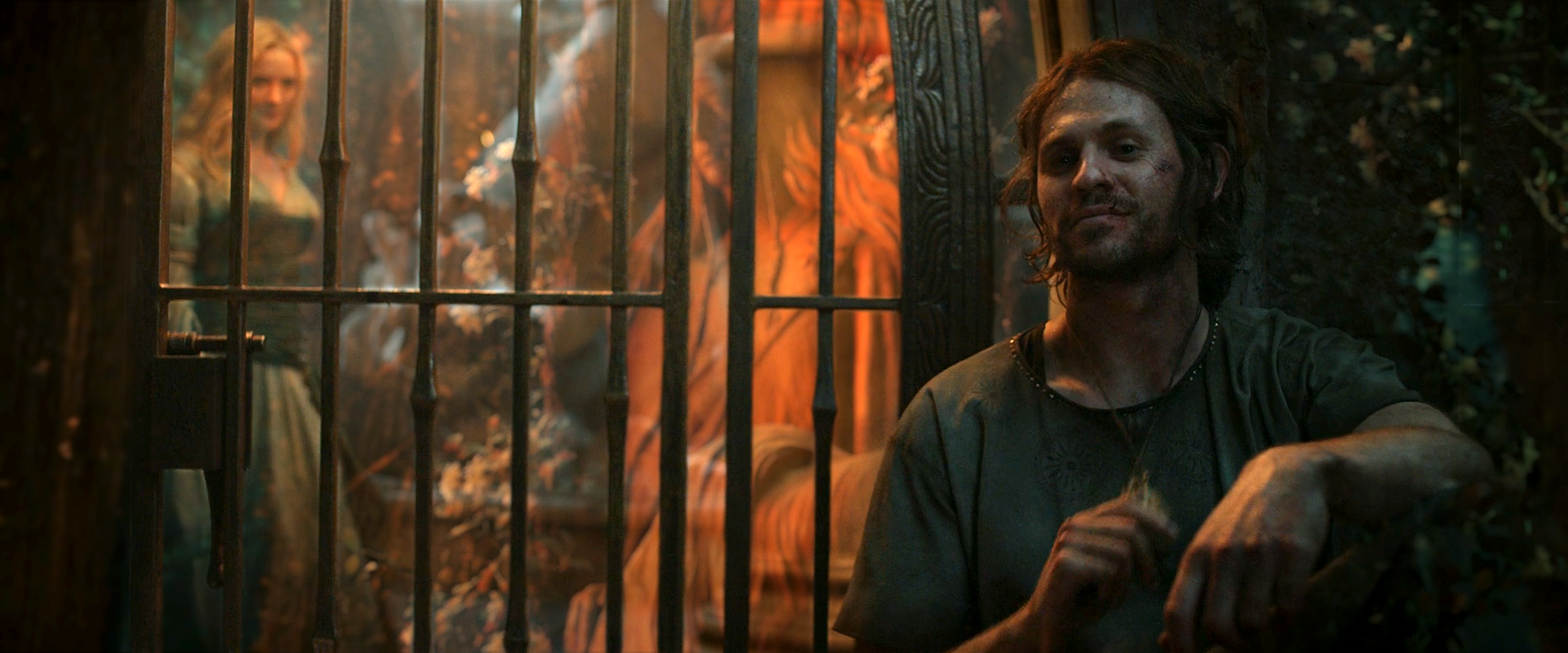
“Please. Don’t do this” (Sauron, 1×03).
AND BEING BOLD AND DESPERATE HE ESCAPED BOTH DEATH AND BONDS
In this particular instance, there was no death to evade at first. If anyone were under the necessity of surviving, it would be Sauron’s victims. Tamar used a knife in defense, but Sauron barely noticed. Every move was incredibly calculated, and he never exhibited any desperation in his actions; only fury.
In the end, he boldly escaped his bonds.

AND THE DEEDS OF LONELY DARING THAT HE ACHIEVED WERE NOISED ABROAD THROUGHOUT BELERIAND, AND THE TALE OF THEM CAME EVEN INTO DORIATH
The results of this fight were announced throughout Armenelos, and the tale of them even caught Míriel’s attention. Sauron’s deeds were noised abroad in a negative light, unlike Beren’s.
“Elf’s mate attacks four guildsmen, and Míriel has her up for tea!” (Tamar, 1×04).

“You vex me, Elf. I welcome you as a guest, and you gallop off to our countryside to steal ancient scrolls, whilst your Southlander companion assaults our citizenry. […] King or carpenter, the Southlander will face judgment” (Míriel, 1×04).
Now, let us explore some things we have not seen, but read.
Type 2: Notice that the whole sentence explains the time between Sauron’s evasion of the judgment of Manwë and the beginning of the series.
SAURON DID NOT FEAR DEATH, BUT ONLY CAPTIVITY
Again, as much of a nuisance as it is, he can return from death; so that is not what he feared. He feared the same fate which Morgoth faced after his first defeat, when Utumno was overthrown: being “cast into prison in the fastness of Mandos, whence none can escape, neither Vala, nor Elf, nor mortal Man. Vast and strong are those halls, and they were built in the west of the land of Aman.”
Of the Coming of the Elves and the Captivity of Melkor
“And some hold […] that Sauron in truth repented, if only out of fear […] [Eönwë] commanded Sauron to return to Aman and there receive the judgement of Manwë. Then Sauron was ashamed, and he was unwilling to return in humiliation and to receive from the Valar a sentence, it might be, of long servitude in proof of his good faith; for under Morgoth his power had been great.”
In other words:
BEING BOLD AND DESPERATE, SAURON ESCAPED BOTH DEATH AND BONDS
“This mark’s very existence proves Sauron escaped” (Galadriel, 1×01).

Ironically, Sauron could not escape the bonds of Morgoth.
“Therefore when Eönwë departed he hid himself in Middle-earth; and he fell back into evil, for the bonds that Morgoth had laid upon him were very strong.”
Of the Rings of Power and the Third Age
The remainder of ¶1 perfectly describes Sauron’s position in the last two applications (not from his own perspective, but from Beren’s).
At length Morgoth set a price upon his head no less than the price upon the head of Fingon, High King of the Noldor; but the Orcs fled rather at the rumour of his approach than sought him out. Therefore an army was sent against him under the command of Sauron; and Sauron brought werewolves, fell beasts inhabited by dreadful spirits that he had imprisoned in their bodies.
Type 3: If we rewind even further to before Morgoth fell, there is a specific deed of Sauron’s that may tie into everything, from his fear of captivity to his deeds being noised abroad (see Sauron Unchained). The inverse lies in Beren’s victory and Sauron’s utter failure, which set a pivotal course for both characters. The correlation with this excerpt is literal because of his one mistake.
Now, the question is: Even at that time, before Morgoth’s defeat, if Beren represents Sauron, who does Sauron represent? Does this reaction not allude to his own experience?
“My closest friend conspired with the King to exile me” (Galadriel, 1×05).

Type 4 is the topic of the next page. Solidify that last excerpt in your mind as we proceed.
Adar’s going to have to do some saying sorry at some point, though.