
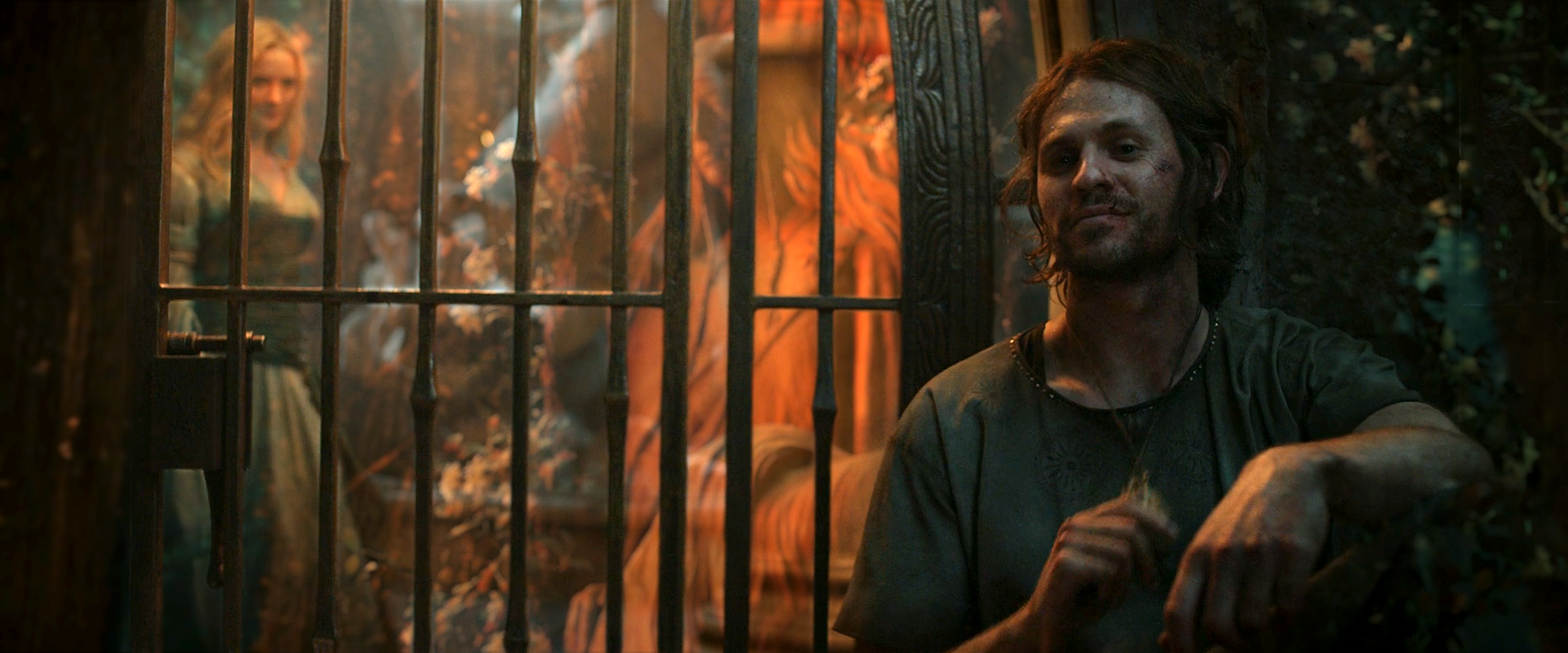
¶ 5: He Saw Her Afar
But she vanished from his sight; and he became dumb, as one that is bound under a spell, and he strayed long in the woods, wild and wary as a beast, seeking for her. In his heart he called her Tinúviel, that signifies Nightingale, daughter of twilight, in the Grey-elven tongue, for he knew no other name for her. And he saw her afar as leaves in the winds of autumn, and in winter as a star upon a hill, but a chain was upon his limbs.
One of the greatest mysteries in The Silmarillion is what Sauron was doing and where he was after being defeated by Lúthien and Huan. He fled into Taur-nu-Fuin and dwelt there, but he was never again mentioned until Of the Rings of Power and the Third Age at the fall of Morgoth. No one knows what happened, but this T.V. series, with the parallels between Sauron and Beren, may provide some answers.
Finrod died, Galadriel claimed the dagger, and Sauron was immediately aware of her.
But she vanished from his sight; and he became dumb, as one that is bound under a spell, and he strayed long in the woods, wild and wary as a beast, seeking for her.
Sauron strayed long in the woods, wild and wary as a beast.
“And immediately [Sauron] took the form of a vampire, great as a dark cloud across the moon, and he fled, dripping blood from his throat upon the trees, and came to Taur-nu-Fuin, and dwelt there, filling it with horror.”
Of Beren and Lúthien
Added to the mix is the idea of him seeking for her (Galadriel) in this condition, after she apparently vanished from his sight. He did so as one that is bound under a spell (a reverie), enchanted by some power. For centuries, Galadriel hunted Sauron, unaware that Sauron also sought for her.
Is he calling her to him?
Now, it would be difficult for Galadriel to vanish from Sauron’s sight. Something drastic would have to happen in order for him to even momentarily lose sight. Beren did not lose sight of Lúthien forever; likewise, Sauron would see Galadriel again, even if he lost her for a short time. A passing statement such as, “She vanished from his sight,” may be a sign of a specific ordeal.*
* We briefly hinted towards this in ¶1, and we will hypothesize at the end of this ¶.
In his heart he called her Tinúviel, that signifies Nightingale, daughter of twilight, in the Grey-elven tongue, for he knew no other name for her.
Sauron may have known of Galadriel’s existence for centuries, but he still asked for her name when he finally found her. When she took the dagger, Sauron perceived her kind (a powerful Elf), but he also knew these things about Finrod and could never identify him. Similarly, Galadriel’s appearance would not reveal her name.
More mirroring of Lúthien:
- Tinúviel, that signifies Nightingale, daughter of twilight.
- Galadriel of the Noldor, daughter of the Golden House of Finarfin.
And he saw her afar as leaves in the winds of autumn, and in winter as a star upon a hill, but a chain was upon his limbs.

First, let us find a manifestation of: “And he saw her afar.” J.D. Payne said Sauron sees Galadriel; did he mean Sauron could only perceive Galadriel, or did he speak literally?
Hi, it’s Melanie again from 2024:
This is an example of my perspective changing. I wrote this leaning more towards a literal meaning of Sauron “seeing” Galadriel, but in light of recent interviews with J.D. Payne and Patrick McKay, I’m now fully on the side of him simply “perceiving” her. Keep in mind that I recognize the intentions of the showrunners and creative team are often different from my theories—especially those solely based on visual imagery; but it’s fun to speculate. The following is what the theory used to be, but just for fun, I will write a separate revision of this theory to align as closely as possible with what is certain.
This is the last shot of the Three Rings from epsiode 8:

If a person knows what another person is watching, simply by viewing the reflection in their eye, what does that mean for the reflection in Sauron’s Eye? He was looking at Mount, but notice the lingering reflection of the Three Rings before the lightning strikes. What if the transition from the Rings to Sauron’s Eye was not purely for aesthetic?
“…[the Elves] took thought, and they made Rings of Power. But Sauron guided their labours, and he was aware of all that they did; for his desire was to set a bond upon the Elves and to bring them under his vigilance.”
Of the Rings of Power and the Third Age
We have a hypothesis to test: that the transition to the Eye illustrated that Sauron was aware of all that the Elves did because he watched them.
I know little to nothing about cinematography, but as far as I know, if centered focal points are utilized in a film, there is always a specific reason, such as creating emphasis. (The motion of the camera is also important.) Below are some examples of more standard angles, where the focal point is to the side.

These shots are centered:

Directly downward-facing, twisting camera angles seem more peculiar and even less common than the above centered shots. One of their uses may also be for emphasis, and in cases like these, each instance establishes a pattern or motif. Now, we must work backwards to discover said motif. The particular shot leading to the Eye is only one of about eight in the whole sequence.


The transition to the Eye seemed to reveal that this particular over-head shot was Sauron’s point of view. With the idea that Sauron saw each of these things, including Elrond’s investigation into his (Halbrand’s) true identity, one is compelled to shrink with a crippling sense of vulnerability. It suggests no one was ever safe from Sauron’s gaze; “he was aware of all that they did.” This explains why his subsequent smirk of approval was not a generic, evil smile he saw that Galadriel “simply let the work proceed.”*
* Although Galadriel believed she tricked Sauron’s system in making three rings instead of two, no one knew that Sauron intended to put a bond upon the Elves. The Elves will not realize the folly of letting the work proceed until Sauron forges the One Ring.
Rewinding further, the last sequence in episode 8 was not the only appearance of this motif. We see it at least once in each episode. One of the earliest instances is the manifestation of the line: “And he saw her afar as leaves in the winds of autumn.”
Galadriel: “I intend to ask of the King a fresh company.” […]
Elrond: “In an act of magnanimity, he has chosen to honor your accomplishments, rather than dwell upon your insolence. Test him again, and you may find him less receptive than you might have hoped” (1×01).

This would reveal exactly how Sauron knew she was cast out for “deigning to beg them for a few, petty soldiers.” He saw it.
Now, we must analyze: “…but a chain was upon his limbs.”
Beren’s figurative chain illustrated his inability to actively pursue Lúthien, courtesy of his enchantment. Sauron’s chain would also represent his inability to find Galadriel, since he was in such a weakened state for centuries. But what if, at some point, Sauron had a literal chain?
BELOW IS ESSENTIALLY A SUMMARY OF SAURON UNCHAINED
In episode 8, Sauron recounted Morgoth’s defeat from his own perspective.
“When Morgoth was defeated, it was as if a great, clenched fist had released its grasp from my neck. And in the stillness of that first sunrise, at last! I felt the light of the One again. And I knew, if ever I was to be forgiven, that I had to heal everything that I had helped ruin” (Sauron, 1×08).

This was not to imply that Sauron hated Morgoth all along, or that Morgoth alone forced Sauron to commit evil deeds. The writers and showrunners did not change anything about Sauron’s character, nor did they have to add anything for nuance. Everything was already there.
Since the sun had existed for centuries before Morgoth fell, Sauron was not speaking of the first sunrise, like Galadriel did in episode 2. He spoke of the sun that rose at the time his story began: “when Morgoth was defeated.” This was quite a marked sunrise.
“Before the rising of the sun Eärendil slew Ancalagon the Black, the mightiest of the dragon-host, and cast him from the sky; and he fell upon the towers of Thangorodrim, and they were broken in his ruin. Then the sun rose, and the host of the Valar prevailed, and well-nigh all the dragons were destroyed; and all the pits of Morgoth were broken and unroofed, and the might of the Valar descended into the deeps of the earth. […]
Thus an end was made of the power of Angband in the North, and the evil realm was brought to naught; and out of the deep prisons a multitude of slaves came forth beyond all hope into the light of day, and they looked upon a world that was changed.”
Of the Voyage of Eärendil and the War of Wrath
Sauron was Morgoth’s greatest servant, yet he sounded relieved that Morgoth fell. Surely, he would do this if he wanted Galadriel to believe he was never a friend to Morgoth, omitting details of his dismay and fear of the gods, his refusal to return to Aman, etc. But he did not lie. Sauron manipulated Galadriel with the truth to make it easier for her to have compassion for him than if his story was a pure fabrication. Given that “under Morgoth his power had been great,” why would Morgoth’s demise be a relief?
The context from “that first sunrise” highlights a very conspicuous detail. The multitude who emerged from the deep prisons were not servants like Orcs and Balrogs, but slaves who were captured, imprisoned, and sent deep into the mines to dig. Sauron described his experience from their perspective.
Sauron | “When Morgoth was defeated, it was as if a great, clenched fist had released its grasp from my neck. And in the stillness of that first sunrise, at last! I felt the light of the One again. And I knew, if ever I was to be forgiven, that I had to heal everything that I had helped ruin” (1×08).
The Silmarillion | “Before the rising of the sun Eärendil slew Ancalagon the Black […] Then the sun rose, and the host of the Valar prevailed […]. Thus an end was made of the power of Angband in the North, and the evil realm was brought to naught; and out of the deep prisons a multitude of slaves came forth beyond all hope into the light of day, and they looked upon a world that was changed.“
Sauron’s was no general fear.
“What do you know of darkness?” (Sauron, 1×05).

Let us finally look at the moment he disappeared in The Silmarillion.
“Then Sauron shifted shape, […] but he could not elude the grip of Huan without forsaking his body utterly. Ere his foul spirit left its dark house, Lúthien came to him, and said that he should be stripped of his raiment of flesh, and his ghost be sent quaking back to Morgoth; and she said: ‘There everlastingly thy naked self shall endure the torment of his scorn, pierced by his eyes, unless thou yield to me the mastery of thy tower.’
Then Sauron yielded himself, and Lúthien took the mastery of the isle and all that was there; and Huan released him. And immediately […] he fled, dripping blood from his throat upon the trees, and came to Taur-nu-Fuin, and dwelt there, filling it with horror.”
Of Beren and Lúthien
Sauron was never mentioned again until Morgoth was gone. Where was he? Did the Successor watch idly by as War ensued? Did Morgoth’s most devoted and powerful servant accomplish nothing noteworthy in the fight against the Valar?
Perhaps. But Sauron knew the consequences of failing Morgoth. In a lose-lose situation, he chose to yield to Lúthien and keep his physical form. As a result, Beren and Lúthien successfully trod into Angband and took a Silmaril from Morgoth’s crown, which ultimately led to Morgoth’s downfall.
“You can go whimpering back to your master and tell him that you’ve let me in. You’ve failed. You haven’t defended your kingdom.” […] I read from that this thing that Morgoth is so powerful and so scary, that it would’ve meant consequences for Sauron.
Sauron yielded to Lúthien in order to avoid punishment and scorn; but how long would it have been before Morgoth discovered that everything surrounding the theft of one of his Silmarils was Sauron’s fault? How long would it have taken Morgoth or a company to hunt Sauron as he fled?
END OF SUMMARY
We ask again, from ¶1: Does this reaction not allude to his own experience?
“My closest friend conspired with the King to exile me” (Galadriel, 1×05).

Sauron failed Morgoth, miserably, suffered punishment, and Galadriel vanished from his sight. He saw her afar, but a chain was upon his limbs. It is no wonder he disappeared for centuries, then reminisced the first sunrise after the War of Wrath, as if he had been among the multitude of slaves that emerged from the deep prisons “beyond all hope into the light of day.” At last! he was free from the chain upon his limbs; a great, clenched fist had released its grasp from his neck.