
(Here is the continuation of ¶3, with the first sentence of ¶4.)
Beyond lay the wilderness of Dungortheb, where the sorcery of Sauron and the power of Melian came together, and horror and madness walked. There spiders of the fell race of Ungoliant abode, spinning their unseen webs in which all living things were snared; and monsters wandered there that were born in the long dark before the Sun, hunting silently with many eyes. No food for Elves or Men was there in that haunted land, but death only. That journey is not accounted least among the great deeds of Beren, but he spoke of it to no one after, lest the horror return into his mind; and none know how he found a way, and so came by paths that no Man nor Elf else ever dared to tread to the borders of Doriath. And he passed through the mazes that Melian wove about the kingdom of Thingol, even as she had foretold; for a great doom lay upon him.
It is told in the Lay of Leithian that Beren came stumbling into Doriath grey and bowed as with many years of woe, so great had been the torment of the road.
We have referenced The Roots of Hithaeglir many times, so here is Elrond’s whole recount, with Gil-galad’s addition:
“It speaks of a battle high among the peaks of the Misty Mountains. Not over honor or duty, but over a tree, within which some claim was hidden the last of the lost Silmarils. On one side fought an Elven warrior with a heart as pure as Manwë, who poured all his light into the tree to protect it. On the other, a Balrog of Morgoth, who channeled all his hatred into the tree to destroy it. Amidst their duel unending, lightning ensnared the tree, forging of their conflict a power as pure and light as Good, as strong and unyielding as Evil. They say it seeped down the roots into the mountain depths, where for centuries now, it has waited” (1×05).
Before our small detour, we established an order to Sauron’s actions.
- Sow Lies
- Reap Harvest
- Go Home
We said then: “Númenor is possibly the only destination that has an inverse to ‘where no mortal foot had yet trodden,’ but technically, all three steps in Sauron’s ‘cultivating process’ are associated with their own Hidden Kingdom.” As with any sequence of events, each step must have a starting point, and this connection with the term “hidden kingdom” is very useful to determine them. Having done so for steps 2 and 3 (Númenor, where Sauron began to reap, and Mordor, where he will take the first steps of his plan), we set out to discover the location for step 1, where he began his lies. Now, look again at his theoretical path from Ered Mithrin to the Ephel Arnen:

The lie which Sauron spread was the song of The Roots of Hithaeglir, which is just a fun way of saying “the song of Mithril.” This directly associates Step 1 with mithril and the only hidden kingdom in Hithaeglir: Khazad-dûm.
- Sow Lies — Khazad-dûm
- Reap Harvest — Númenor
- Go Home — Mordor
Now, since we do not know exactly when Adar betrayed Sauron, it is difficult to say whether Khazad-dûm was founded in time for Sauron to travel through the actual kingdom. Luckily, Dwarves are beside the point. The point is that Sauron traveled through that area (Hithaeglir) and Elven territory.
This is why I made the detour:
Beyond lay the wilderness of Dungortheb, where the sorcery of Sauron and the power of Melian came together, and horror and madness walked.

Sauron traveled through the Misty Mountains (the setting of his apocryphal story), wherein it is said that powers of Good and Evil came together. Beren traveled through a wilderness “where the sorcery of Sauron and the power of Melian came together.” That is no Easter egg. Sauron knows what he is doing.
“Where I came up, precious metals were scarce as hens’ teeth. So, we learned to combine them to harness strengths and hide flaws” (Sauron, 1×08).
In order to conjure an idea convincing enough to fool Elves, Sauron would need to base it on an actual, historical event. There was no literal tree that hid a lost Silmaril, and no Elf or Balrog that fought over it. It is symbolic. He based his actions and appearance around Beren, but what would he twist to form the song of mithril? There are two options which might be coexistent, but we will only talk about one of them until page 12. This option would be: his own battle with Melian.
Two sentences from Beren’s travels reveal the symbolism: the hatred of the Balrog of Morgoth represents Sauron’s sorcery. The light of the Elven warrior represents the power of Melian, a Maia in the form of an Elf. Sauron’s duel with her was seemingly unending, as was the battle between the Elf and the Balrog. What do the tree and lightning symbolize? What was the Balrog trying to destroy that the Elf used all his light to protect, and in what was it ensnared?
There spiders of the fell race of Ungoliant abode, spinning their unseen webs in which all living things were snared; and monsters wandered there that were born in the long dark before the Sun, hunting silently with many eyes.
Beren’s friendship with birds and beasts was partially paralleled by the Worm inadvertently aiding Sauron. Now, this is extremely speculative, but a closer parallel might be that Sauron became the friend of different kinds of beasts, and one beast in particular aided him and did not betray him. It is possible that while he was in Hithaeglir, he encountered one spider of the fell race of Ungoliant, and plotted with her against the Eldar, as Morgoth “with Ungoliant plotted his revenge” (Of the Darkening of Valinor).
What would this plot be? Read the whole detour again (pages 6-8). The Great Tree was poisoned, and it appeared that the Elves were dying. The only antidote seemed to be mithril.
Now that we have come to Hithaeglir in Sauron’s timeline, let us consider how, when, and why mithril was the only cure.
First of all, Sauron did not create mithril. This means Aulë created mithril, like all elements, and it was already in the depths of the earth when Sauron was in Hithaeglir. Yet, it was likely always a peculiar material, courtesy of a (potential) previous corruption.
“Melkor was jealous of him, for Aulë was most like himself in thought and in powers; and there was long strife between them, in which Melkor ever marred or undid the works of Aulë, and Aulë grew weary in repairing the tumults and disorders of Melkor.”
Valaquenta
This explains mithril being perilous to mine, as well as “lighter than silk, harder than iron,” as Durin described, making it exceedingly valuable. How did Sauron contribute?
Mithril did not always possess the power which allowed it to heal the leaf.

Originally, Sauron was a Maia of Aulë, which association would render Sauron immensely familiar with all of Aulë’s works, including mithril: its location, unique properties, and how it was made. Later, in the beginning of Arda, Sauron joined Melkor and had part in all his deeds, “in his vast works and in the deceits of his cunning.” This means he would know how mithril was corrupted.
“Where I came up, precious metals were scarce as hens’ teeth. So, we learned to combine them to harness strengths and hide flaws. I’ve seen a trace of nickel added to iron to make a blade lighter and stronger. Might there not be some alloy to amplify the qualities of your ore?” (Sauron, 1×08).
Knowing the nature of mithril so intricately, he would know how to use sorcery to tamper with it—harnessing its strengths while hiding flaws that Melkor gave it. This would allow him to craft a power over flesh, with which he could heal Middle-earth and still become master over other wills.
When would he have tampered with mithril?
We know that in Dúrnost, Sauron meddled with the powers of the Unseen World. The disastrous results of his experiments were echoed by those in Eregion because the same power was tested. But the difference in severity showed that the powers in Dúrnost were in larger quantities. Now, a small scrap of mithril being used in Eregion does not necessarily prove that Sauron used mithril in the North,* but rather that the power originated from him. The power is his.

* Sauron sought to craft this power before Finrod died, but if he successfully altered mithril before Morgoth’s defeat, he would have found a way to test it in Dúrnost. To yield such significant results as Galadriel found, Sauron would have gathered so much mithril that Galadriel would have found scraps when she looked around. But she found nothing except some tools and a mark.
We know that Sauron did not yet possess the knowledge which would later allow him to craft the One Ring. In the North, he sought for that knowledge. He harnessed most of his power in the One Ring, but in order to perfect such a craft, he would need a prototype. Perhaps mithril contains a power of preservation because Sauron was successful in his experiments. But how would he harness his power in mithril if he was not physically in the Misty Mountains?
The power is of the unseen world, and there is a connection between Sauron’s forge and a Balrog, which happens to be the creature that guards the mithril.

“But try as he might, something was missing,” in Forodwaith. Sauron could not find the shadow of dark knowledge until he was in Eregion, where he said:
“Galadriel! We found it. I don’t know how we missed it before!” (1×08).
Sauron finally realized that he used too much force in Forodwaith, and there was too much power for one object. Still, the aftermath showed that something happened in Forodwaith. Again, perhaps he was successful, but his mistakes explain why his power was distributed throughout the entire deposit of mithril, instead of a single object.*
* I have an idea of where we see/hear the exact manifestation of this event, which I included in Sauron Rebuilt.
Unfortunately for Sauron, before he had the chance to find a way to use the new and improved mithril to craft something that would accomplish his purpose, Adar betrayed him. He already channeled much of his power in mithril, so he was diminished and vulnerable.
So, we see that when Sauron was in Hithaeglir, mithril was no longer an issue. The power was already there, so he only had one item of business. (Again, speculative): As Morgoth and Ungoliant plotted to destroy the light in Valinor, Sauron and Shelob plotted to destroy the light of the Eldar, or make it appear so. Mithril may be considered the antidote to the poison, but it is much more simple than that.
“…Sauron most desired to possess [the Three Elven Rings], for those who had them in their keeping could ward off the decays of time and postpone the weariness of the world.”
Of the Rings of Power and the Third Age
Sauron crafted a power to heal and rehabilitate Middle-earth, not the Elves. The tree was poisoned, not the Elves. The leaf was healed, not the Elves.
“He was seeking a power. Not to destroy Middle-earth, but to heal it. Just as your fellow-Elves are seeking to do this very moment” (Sauron as Finrod, 1×08).
Sauron revealed to Galadriel that the Elves were not crafting a power to save themselves, like they believed, but rather to heal the world.
“After Morgoth’s defeat, the one you call ‘Sauron’ devoted himself to healing Middle-earth, bringing its ruined lands together in perfect order” (Adar, 1×06).
That is why the Elven lands are preserved by the Three Rings. That is why Lothlórien would fade if the One Ring was destroyed, and not the very souls of the Elves. The leaf was healed by the mithril because that is what the power was meant to do. It works! But Sauron allows the Elves to believe it is to save their souls.
Back to our questions: “What do the tree and lightning symbolize? What was the Balrog trying to destroy that the Elf used all of his light to protect, and in what was it ensnared?” The lightning parallels the unseen webs of Ungoliant’s descendants, which ensnared the tree (a.k.a. “all living things”).
Hi, this is Melanie, speaking on December 30, 2024:
It’s apparent that when I wrote this, I fixed my sights on connecting the passage with literal spiders. However, you may have noticed a much stronger parallel between “unseen webs” and powers of the “unseen world,” which Sauron uses to ensnare people. I may make a post to reflect on my claims here, now that season 2 has been released. Moving on.
No food for Elves or Men was there in that haunted land, but death only.
Beren traveled through a land wherein there was no food. Sauron traveled through a place riddled with mithril, a supposed “food for life,” according to the lies that he spread, but the truth is that the only thing awaiting “all living things” was death. The armies of darkness would march over the face of the earth if the Elves left. If the Elves stayed and refused Sauron’s “gift” (mithril), they would fade quickly, “and the shadow will spread and darken to cover all the world.” The same would happen if the Elves stayed and accepted the gift, only they would face a more severe type of fading. Sauron wins.
Now, since Sauron crafted his persona around Beren, it is not difficult to imagine him reading this next sentence, as if speaking of his own great deeds.
That journey is not accounted least among the great deeds of Beren, but he spoke of it to no one after, lest the horror return into his mind; and none know how he found a way, and so came by paths that no Man nor Elf else ever dared to tread to the borders of Doriath.
In his own words:
“You don’t know what I did before I ended up on that raft. You don’t know how I survived. How we all survived. And when these people discover it, they will cast me out. So will you” (1×05).
We still do not know how Sauron journeyed from Forodwaith to the Southlands. We only suspect where and why. Nor do we know what he did between the Southlands and Númenor. There is a large gap in his timeline.
Approaching the end of ¶3, we are suddenly pushed past several centuries of Sauron’s backstory, for none know how he found a way. Including us.
And he passed through the mazes that Melian wove about the kingdom of Thingol, even as she had foretold; for a great doom lay upon him.

The above constellation of stars was seen at sea, by Galadriel, and Melian’s mazes were woven about Doriath. If Doriath consistently parallels Númenor, the mazes would be woven in the sea. This brings us to Sauron’s sail from Harad into the Sundering Seas (the beginning of season 1).

Although the Sundering Seas were already perilous, the obstacles Sauron encountered were not random. Melian is a Maia, so what other Maia or Vala might fit the description of weaving mazes about Númenor? The most obvious choices of the Maiar are Ossë and his wife, Uinen.
Ossë is a questionable option. He is only “master of the seas that wash the shores of Middle-earth. He does not go in the deeps, but loves the coasts and the isles.” He will “rage in his wilfulness without any command from Ulmo,” but only those who “dwell by the sea or go up in ships” do not trust him.

Uinen is more likely, since her hair “lies spread through all waters under sky.”
“The Númenóreans lived long in her protection, and held her in reverence equal to the Valar.”
Valaquenta
However, she protects them by calming the waters, instead of provoking them. She tempers the wildness of Ossë.

This rules out the Maiar.
Of the Valar, Ulmo was unquestionably involved. He is the Lord of Waters, and “before Valinor was made he was closest to [Manwë] in friendship; but thereafter [Ulmo] went seldom to the councils of the Valar, unless great matters were in debate.”
Valaquenta
Would these matters not be great, considering they (the Valar) apparently sent the Stranger? Galadriel, Gil-galad, Míriel, Pharazôn, and the other significantly influential figures of Arda were not the only ones Sauron sought to deceive. He hid himself in Middle-earth because he feared the gods. “The gods are always watching.”

Every Vala and Maia was aware of Sauron’s track record, and as far as Sauron knew, they were possibly aware of his whereabouts. Most of them would not believe that he had any good intentions, though there might be some who would be convinced by his so-called remorse for a moment. Compare Sauron’s circumstances to the time that Melkor (Morgoth) was chained:
“Before the gates of Valmar Melkor abased himself at the feet of Manwë and sued for pardon, vowing that if he might be made only the least of the free people of Valinor he would aid the Valar in all their works, and most of all in the healing of the many hurts that he had done to the world. And Nienna aided his prayer, but Mandos was silent.
“Then Manwë granted him pardon; but the Valar would not yet suffer him to depart beyond their sight and vigilance, and he was constrained to dwell within the gates of Valmar. But fair-seeming were all the words and deeds of Melkor in that time […] and therefore in a while he was given leave to go freely about the land, and it seemed to Manwë that the evil of Melkor was cured. For Manwë was free from evil and could not comprehend it […] and he saw not to the depths of Melkor’s heart, and did not perceive that all love had departed from him for ever. But Ulmo was not deceived, and Tulkas clenched his hands whenever he saw Melkor his foe go by.”
Of Fëanor and the Unchaining of Melkor
Sauron also abased himself and sued for pardon, vowed to heal everything that he had helped ruin, used fair-seeming words, and had the appearance of the evil within him being cured; but all love had already departed from him forever, if Melkor is any indication. When Melkor swayed even Manwë, who saw through Melkor’s guise? When Sauron followed Melkor’s every step and said he had plans, who would have sent the storm?
Sauron: “I’ve got my own plans, Elf.”
[storm suddenly brews]
Galadriel: “Prepare yourself” (1×02).
Sauron passed through the mazes that Ulmo wove about Númenor.

Sauron would know who sent the storm. He only survived because “Ulmo loves both Elves and Men, and never abandoned them, not even when they lay under the wrath of the Valar.” Galadriel was Sauron’s shield.
“On the raft, you saved me” (Sauron, 1×08).
Now, Beren passed through Melian’s mazes, even as she had foretold. What does her prophecy parallel? What foretelling existed of Halbrand being stranded at sea, them stumbling into Númenor? —The prophecy in the Palantir; the Downfall of Númenor.
We are told that Thingol “was troubled by dreams concerning the coming of Men, ere ever the first tidings of them were heard.” He said:
“Into Doriath shall no Man come while my realm lasts, not even those of the house of Bëor who serve Finrod the beloved.”
At that time, it was Galadriel to whom Melian prophesied:
“Now the world runs on swiftly to great tidings. And one of Men, even of Bëor’s house, shall indeed come, and the Girdle of Melian shall not restrain him, for doom greater than my power shall send him; and the songs that shall spring from that coming shall endure when all Middle-earth is changed.”
Of the Coming of Men into the West
Generations after Númenor shunned the Elves, we were shown that Míriel was troubled by dreams concerning the coming of an Elf, as she believed, which coming would lead to the downfall of her kingdom. Once again, the prophecy was revealed to Galadriel, to whom Míriel bid see the vision in the Palantir. Then she said:
“It is Númenor’s future you saw. […] It has already come to pass. The vision begins with your arrival” (Míriel, 1×04).
Beren’s coming was foretold, as well as Sauron’s. Míriel’s attention was simply drawn to the wrong person. The vision in the Palantir did not begin with Galadriel’s arrival, but rather Sauron’s arrival. He is the one who brings about Númenor’s downfall. He used Galadriel as a shield at sea, then as a key into Númenor, knowing that an Elf would divert any and all attention away from him.
We have already suggested that Galadriel recognized similar traits in Halbrand that she might have seen in Beren. She would have remembered what Melian told her about Beren’s arrival: “[…] doom greater than my power shall send him.” Galadriel told Sauron: “[Our meeting] was the work of something greater.” Halbrand’s and Galadriel’s meeting truly was the work of something greater, but Galadriel failed to discern that it was not the work of something good. Even Sauron himself corrected her assessment.
Galadriel: “Ours was the work of something greater. You must see it.”
Sauron: “All I see is an Elf who won’t put down her sword” (1×03).
Many external forces helped Beren, notwithstanding the great doom that lay upon him. On the other hand, Sauron had no assistance from anyone. If he undertook replicating Beren’s experience, he was on his own, with the same external forces, which helped Beren, working against him.
- Defended by fate, Beren escaped death at the hands of the Orcs who murdered his father.
- Beren’s resolve to venture into Doriath was put into his heart by something good.
- Melian foretold (to Galadriel, of all people) of a Man who would venture into the Hidden Kingdom.
- The songs that sprang from Beren’s coming endured when all Middle-earth was changed.
- Beren’s ultimately led to the downfall of Morgoth, which changed the very structure of Middle-earth.
- Knowing how to survive, Sauron escaped death at the hands of the Orcs who betrayed him.
- Sauron shaped in his own heart the resolve to travel south.
- Míriel (by means of the Palantir) foretold to Galadriel of the destruction of Númenor, beginning with the arrival of a supposed Man who would venture into the Hidden Kingdom.
- The songs that shall spring from Sauron’s coming shall endure when all of Arda is changed.
- Sauron’s ultimately led to the downfall of Númenor, which changed the structure of the entire world.
Sauron passed through the mazes that Ulmo wove about the island kingdom of Númenor, even as it was foretold, for a great doom lay upon him.
“And high in the north as a challenge to Melkor [Varda] set the crown of seven mighty stars to swing, Valacirca, the Sickle of the Valar and sign of doom.”
Of the Coming of the Elves and the Captivity of Melkor
Thus ends ¶3, but we must dip into the first sentence of ¶4 to reach the conclusion of Part 1.
It is told in the Ley of Leithian that Beren came stumbling into Doriath grey and bowed as with many years of woe, so great had been the torment of the road.

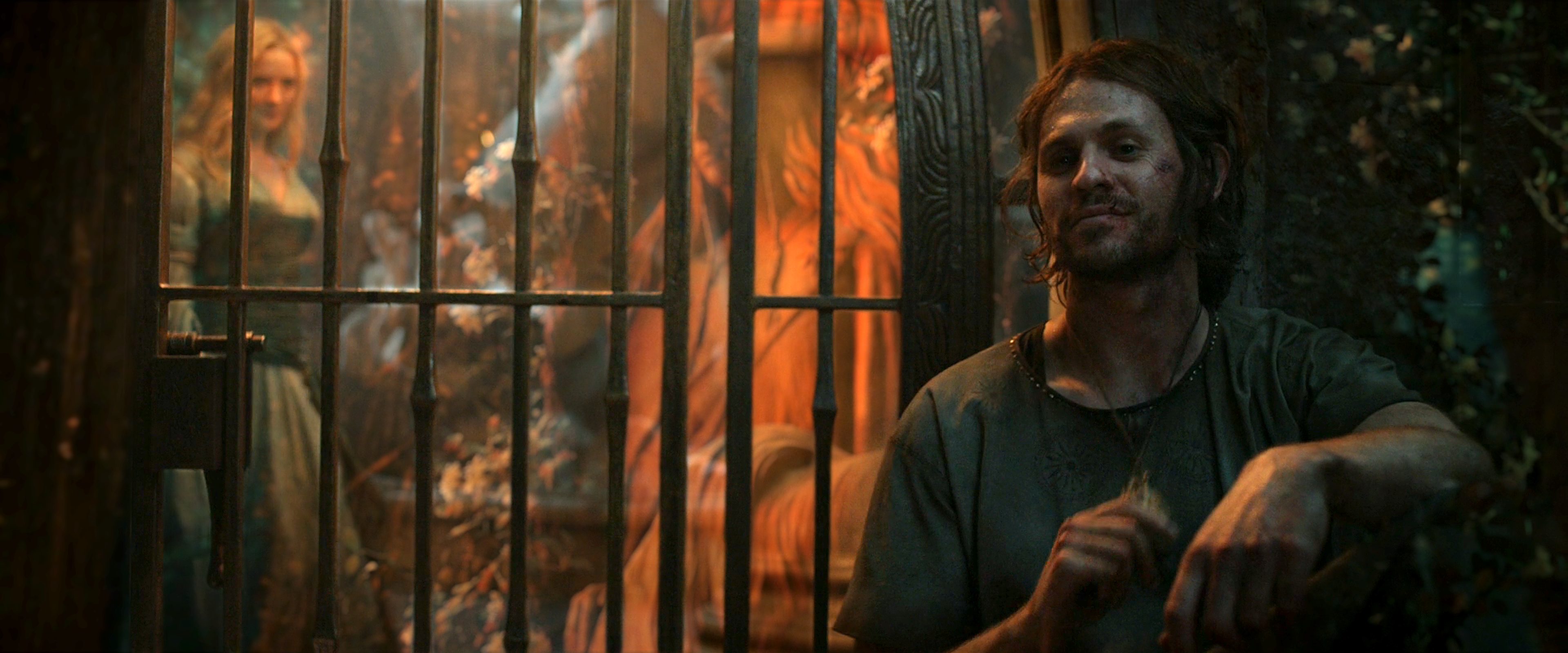
Sauron stumbled into Númenor in the opposite manner of Beren. He smiled, walking with a confidence and energy that is unbecoming of a Man who, only days prior, narrowly escaped a watery grave. He may have been a bit run-down and scabby, and he did speak of his many years of woe*…
“I have been searching for my peace for longer than you know. Please, for both our sakes, let me keep it” (Sauron, 1×03).
…but he was not gray and bowed.
* He had been searching for a way to craft that power over flesh since before Finrod died. That was over three thousand years ago, not just a couple of decades or centuries. “Many years of woe” is a vast understatement.