
¶ 2: Chased from His Homeland
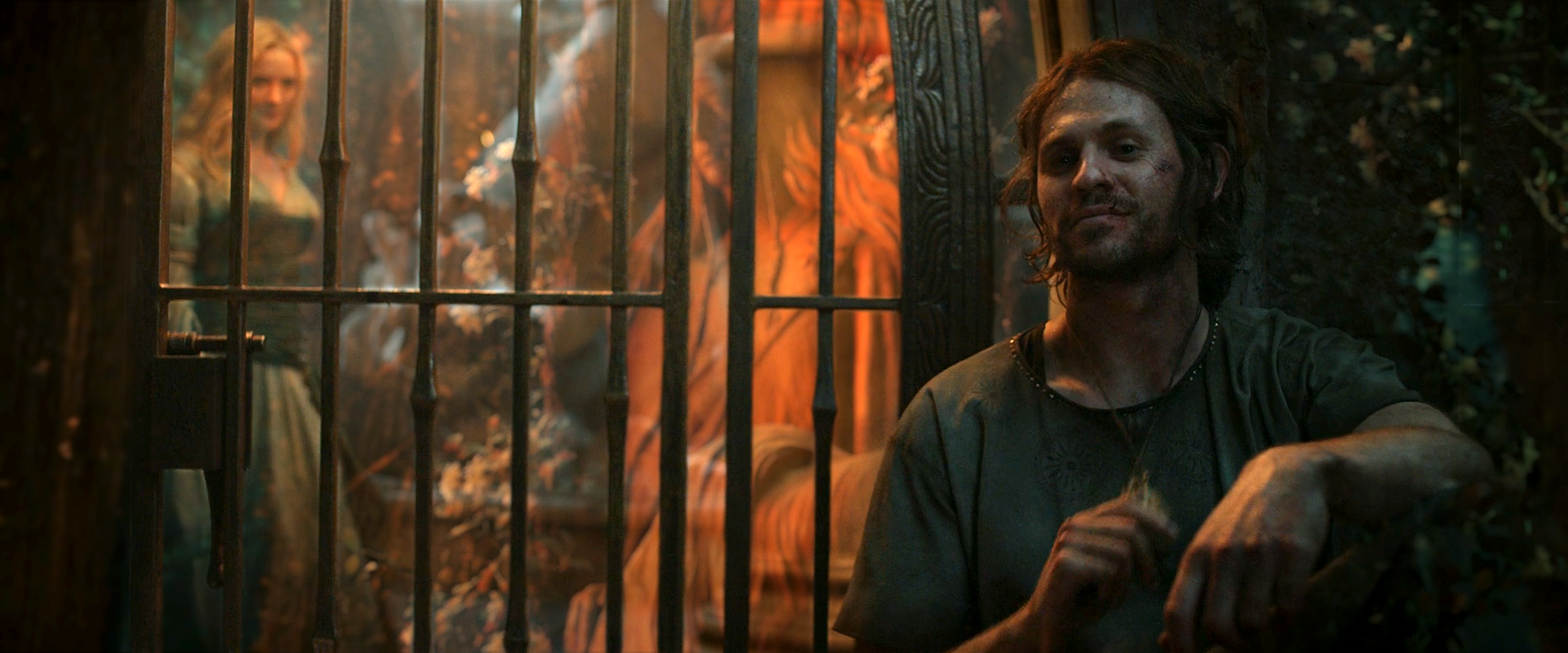
All that land was now become filled with evil, and all clean things were departing from it; and Beren was pressed so hard that at last he was forced to flee from Dorthonion. In time of winter and snow he forsook the land and grave of his father, and climbing into the high regions of Gorgoroth, the Mountains of Terror, he descried afar the land of Doriath. There it was put into his heart that he would go down into the Hidden Kingdom, where no mortal foot had yet trodden.
Adar’s act of treason brought Sauron to his lowest point. I say “act of treason,” instead of “killed,” for a reason. Adar said, “I split him open. I killed Sauron,” but Galadriel responded:
“I do not believe you” (1×06).
If there is one thing I have learned from this show, it is that you cannot trust any ambiguity at face value. Here is what Bear McCreary said about the music of the scene in the barn:
In my initial draft, I aggressively underscored this revelation with a huge swell in the orchestra and a punchy, ominous dark chord. Thankfully, this is one of many moments where collaborative input from showrunners J.D. Payne and Patrick McKay proved ever insightful and helpful. They encouraged me to go the opposite route. Now, the score whispers into a dying gasp and disappears completely just before Adar’s shocking confession that he killed Sauron. The impact is effective: now the audience’s attention is focused fully on actor Joseph Mawle’s cunning depiction of Adar. Is he telling the truth?
Let us accept Bear’s invitation to examine Joseph Mawle’s cunning depiction. Adar’s aimless stare upon saying, “I killed Sauron,” looks like wishful thinking, or an attempt to convince himself that he succeeded. His reaction to Galadriel’s disbelief is quite troubling.
Yes, Sauron has the ability to return from death, and “I split him open” is too specific to disbelieve, but did the injury really kill him? Episode 7 shows another manifestation or echo of what the result might have actually been:
Sauron ran off and risked his life by splitting himself open, but he survived.

We often hear that Sauron has been brought low in power at the beginning of the Second Age, rendering it necessary for him to rebuild. Killing him would certainly diminish his power, but it would not be required.
- incapacitated: deprived of strength or power, debilitated.
- debilitated: in a very weakened and infirm state.
Did Adar truly, entirely, beyond any doubt, separate Sauron’s spirit from his physical form, or did the injury only incapacitate and humiliate him, like when he was defeated by Huan in the First Age? There may be a hint in the following exchange, which cannot be ignored:
Waldreg: “Meaning no offense, Lord-father, but where is he? What happened to Sauron?“
[pause]
Orc: “Can’t find tooth nor tail of him. Must’ve got smart and scarpered” (1×06).
The Orc spoke of Arondir, but the flow of the dialogue shows that he also subtly answered Waldreg’s question. It is possible that Sauron fled, and Adar sought him out. Like Beren, “being bold and desperate,” Sauron “escaped both death and bonds.”
“You don’t know what I did before I ended up on that raft. You don’t know how I survived. How we all survived” (Sauron, 1×05).
Before wandering as a solitary outlaw for four years upon his homeland, Beren (defended by fate) evaded the wild arrows of the Orcs who murdered his father. If Sauron survived his injuries and escaped his pursuers, he might have wandered upon his homeland for a time, until:
All that land was now become filled with evil, and all clean things were departing from it; and Beren was pressed so hard that at last he was forced to flee from Dorthonion.
“The way I see it, it wasn’t Elves that chased me from my homeland. It was Orcs” (Sauron, 1×02).
I have seen theories that Sauron referred to Hordern as his homeland, if only from the perspective of “Halbrand.” There is some evidence in support of the argument, but many more things indicate otherwise. We may explore this further down the line, but for the sake of avoiding excess tangents, suffice it to say that Hordern is not Sauron’s homeland. Was he speaking of another village that we have not seen?
Medhor said that the Orcs ransack village after village, so we know that Hordern was not the first nor last. However, although Halbrand fleeing from an unknown village is entirely possible, if we want to at least try to base theories off of things that we have seen and/or read, and not build upon a foundation of sheer possibilities (for the most part), we must set that aside and consider something more obvious.
What place did Galadriel recall when Sauron mentioned his homeland and Orcs? The mark is a map of the Southlands, but where did she find it?

Galadriel: “Your home. Where was it?”
Sauron: “What’s it matter? It’s ashes now.”
Sauron dodged every question about his past; even the one answer he gave was not in reference to his origin. He never said the Southlands were his home. He only told Galadriel that the Orcs were there.
Sauron: “If you want to murder Orcs and settle the score, that’s your affair, but don’t dress it up as heroism.”
Galadriel: “Are you going to tell me where the enemy is, or not?”
Sauron: “The Southlands” (1×02).
Unfortunately, Galadriel’s presupposition was that “where was your home” and “where is the enemy” were the same question, and she concluded that he was from the Southlands. Sauron only outwardly acquiesced in her perception of his character after she kindly informed him of his descent.
“In the Great War, your ancestors stood with Morgoth” (Galadriel, 1×03).
Míriel ordered, “Name thyself,” and Sauron obeyed:
“Halbrand… of… the Southlands” (Sauron, 1×03).
Aside from that, Sauron never said anything to indicate he was a Southlander, let alone king. He let others do that for him.
“You needn’t lie to them. Simply let the work proceed” (Sauron, 1×08).
Since he never told a single lie, why did he say his homeland was in ashes? He was well aware of Adar’s whereabouts and designs—having been the one who conjured the plan to trigger Orodruin’s eruption in the first place, and Adar stole and used it for his own purposes*—but he also knew that the dam had not yet been unlocked, and the Southlands were fine.
“The Southlands will still be there in three days” (Sauron, 1×03).
* “[…] it is Sauron’s plan that Adar has coopted for his own purposes. […] if you really do the deep, deep, deep dive, you can pick up on all those things, and if you don’t, that’s okay, too” (Patrick McKay).
He would be lying if he said, “It’s ashes now,” as if he believed the mountain had already erupted. But since he has not lied, he has a homeland in ashes. If it is not Hordern or anywhere in the Southlands, the only possibility happens to be the one place whence we know he fled from Orcs.
Beren’s home: “All that land was now become filled with evil, and all clean things were departing from it” (Of Beren and Lúthien).
Sauron’s home: “This place is so evil, our torches give off no warmth” (Galadriel, 1×01).
Sauron would not even blink at a land filled with evil, since he would be the cause of it, but he was still chased or “forced to flee” from it: Forodwaith.

Would Sauron call a stronghold his “home”?
His allies did.
“Then the heralds of Angband showed [Gelmir] forth, crying: ‘We have many more such at home…’”
Of the Fifth Battle: Nirnaeth Arnoediad
Forodwaith is the name of the land, but Dúrnost is the name of the fortress itself. In Sindarin, dûr* means “dark (with evil implications), gloomy, or hellish.” Nost* means “house, or family.” Dúrnost literally translates to Dark House or Family, or The House of the Dark.
* Barad-dûr—Sauron’s “Dark Tower”
* Nost Finarfin—The House of Finarfin
In episode 6, Galadriel said that Adar was of the Moriondor, or the Sons of the Dark, which would make him part of the House of the Dark. Sauron, the head of that house, told Galadriel in episode 3:
“I am not the hero you seek, for it was my Family who lost the war.”
Naturally, the land and building in which such a people lived would be deemed a home, no matter how dark or evil it is, especially by someone who tries to garner sympathy.
So, when Halbrand spoke of surviving and being chased from his homeland, it would make sense for us to assume that he described an event from the Southlands—that is, until we remember that Halbrand is Sauron, and we hear Adar explain what happened in Forodwaith, their former home. This is the only instance which fits both sides of the story with which we are provided. Though there may be more recent instances that fit, we know nothing about them, and any other scenario currently requires more speculation.
In time of winter and snow he forsook the land and grave of his father, and climbing into the high regions of Gorgoroth, the Mountains of Terror, he descried afar the land of Doriath.

According to Charlie Vickers, Sauron’s first steps into Mordor marked the beginning of his plan. This does not mean he had no goals and did nothing until that point, because in order for a plan to be executed properly, it must first be carefully outlined and a foundation must be set. I would like to explore where and when he first constructed his plan. The above image is a manifestation, type, or shadow of this very thing—done probably centuries ago from far-away lands, as he descried a Hidden Kingdom from atop a mountain range.
And something that you’ll see a lot of in the show is this chiastic structuring, within seasons, across seasons, within scenes, within episodes, where you have this rhyme or symmetry—sort of a ring structure—where something you see in the beginning is then mirrored again at the end.
Here is the rhyme:
- Brought low in power.
- Constructs a plan.
- Upon mountains of snow.
- Rebuilt in power.
- Ready to enact the plan.
- Among mountains of fire.
We have not yet seen the beginning of the rhyme, but we may have already read it. Here is what I mean—
Sauron fled from his homeland (Forodwaith) in time of perpetual winter and snow. He did not have a father to bury, let alone a grave to forsake, but Sauron is Morgoth’s successor, which makes Morgoth a type of father-figure. Instead of leaving the grave of his father, Sauron forsook the memory of Morgoth. “He’s leaving his past behind,” as Charlie often said, but he did not leave his past behind in pursuit of true goodness. He may have wanted that to be the appearance, but in reality, since Morgoth was gone, he tried to “leave Morgoth behind” to pursue his own absolute dominion, gladly accepting the role of “Morgoth’s successor.”
Sauron, like Beren, was constrained to flee, and his only possible option was to venture southward. What did his path look like? We know where the Orcs traveled after they freed themselves.
“We cast off our shackles, crossed mountain, field, frost, and fallow, till our feet bloodied the dirt! From Ered Mithrin to the Ephel Arnen, we have endured” (Adar, 1×06).


Sauron may have traveled the same trail before the Orcs, which means he climbed to the top of Ered Mithrin, like Beren climbed to the top of Ered Gorgoroth and “descried afar the land of Doriath.” There are several specific locations towards which Sauron might have directed his attention, if not all of the lands south of Forodwaith. His ultimate design was to rule over all of Middle-earth. To accomplish this, he needed three things: power, forces, and a stronghold.
power
Sauron began with quite the workload, since Adar hindered his designs to such a considerable degree. At the beginning of the season, he had little power, but his power had been diminished for a long time, only to “very slowly reemerge.” At some point, he carefully planted seeds (lies) to reap after centuries. He fits this description of Melkor:
“Long was he at work, and slow at first and barren was his labour. But he that sows lies in the end shall not lack of a harvest, and soon he may rest from toil indeed while others reap and sow in his stead.”
Of the Silmarils and the Unrest of the Noldor
What lies would he spread, and where would he plant them?
Forces
There are several reasons to obtain an army.
“It’s folly to kick against the current. You see, the tide may rise and drown a man, or fall and sweep him out to sea. But the trick of mastering the current is to know which way it will turn next” (Pharazôn, 1×05).
Sauron was always attentive to Adar’s actions and whereabouts, having a monstrous advantage of being able to see/perceive almost anything he seeks. The threat Adar posed of gaining control over the South was of utmost concern, but Sauron had no army. He is more “cool and calculated” than someone like Morgoth (or even Galadriel), and knew that he required armed forces in such a low state.
Galadriel: “What if I told you we might be able to reclaim it?”
Sauron: “I’m afraid you’re short an army.”
Galadriel: “Leave the army to me. Why are you dodging the question?”
Sauron: “Why are you stranded at sea?” […]
Galadriel: “I need to know how many the enemy were, under whose banner they marched, and then you are going to take me to their last known location.”
“Sauron: “I’ve got my own plans, Elf” (1×02).
Where could an army be obtained? (Hint: Where did he obtain one?)
stronghold
In the future, we will see the building of Barad-dûr.
“It speaks not only of a place, but a plan. A plan by which to create a realm of their own, where evil would not only endure, but thrive. A plan to be enacted in the event of Morgoth’s defeat, by his successor” (Galadriel, 1×03).
Of course, the plan was written before the event of Morgoth’s defeat, and Sauron may not have been particularly eager to enact it immediately, if he did not desire its destruction. But the location would always be in his mind. Adar’s rebellion must have increased his resolve and Númenor’s arrival to Middle-earth solidified it.
“…and [Sauron] heard tell also of Aldarion, son of Tar-Meneldur the King of Númenor, now become a great ship-builder who brought his vessels to haven far down into the Harad. Sauron therefore left Eriador alone for a while, and he chose the land of Mordor, as it was afterwards called, for a stronghold as a counter to the threat of the Númenórean landings.”
Unfinished Tales: The History of Galadriel and Celeborn
There is an order to things:
- Sow Lies (for Power)—before season one.
- Reap Harvest (for Forces)—during season one.
- Go Home (Stronghold)—after season one.
Here is where things get tricky:
There it was put into his heart that he would go down into the Hidden Kingdom, where no mortal foot had yet trodden.

(Again, the picture is another Shadow of the Past, or part of a rhyme, but it is worth mentioning another parallel: One could not simply walk into Doriath, but Beren did. “One cannot simply walk into Mordor,” but Sauron did.)
There is a missing piece of information from this sentence, as it applies to Sauron: What was his motive?
Before we search for it, we must establish what the “Hidden Kingdom” is. Where did he begin to reap what he sowed? There must be a parallel or inverse to “where no mortal foot had yet trodden,” but Middle-earth provides neither. Khazad-dûm, which is very much a hidden kingdom, has permitted both mortals and immortals. The Southlands are not hidden until they become Mordor, and Elves and Men had already coexisted in the Southlands for centuries.
Númenor, on the other hand, has the inverse: No immortal foot had trodden there for many generations because the Elves were shunned. Sauron, a Maia, would be one of the first immortals to tread on the island. Additionally, being surrounded by ocean, Númenor was more of a Hidden Kingdom than anywhere in Middle-earth by the time he arrived.

The sentence above (“There it was put into his heart…”) tells of an “idea” which, in Sauron’s case, would not come to fruition for many years. Why would it take so long? —Because although he aimed to prevent Adar from invading the Southlands…
“Your lands, Halbrand” (Galadriel, 1×03).

…Númenor posed the same threat.
“Now [Sauron] learned that the kings of Númenor had increased in power and splendour, and he hated them the more; and he feared them, lest they should invade his lands and wrest from him the dominion of the East. But for a long time he did not dare to challenge the Lords of the Sea, and he withdrew from the coasts.”
Akallabêth
Venturing into Númenor (the “idea”) would be reserved for a later date because he was not prepared; he needed an army. So, “for a long time he did not dare to challenge the Lords of the Sea,” and “for long he dissembled his mind and concealed the dark designs that he shaped in his heart.”
“Now Sauron’s lust and pride increased, until he knew no bounds, and he determined to make himself master of all things in Middle-earth, and to destroy the Elves, and to compass, if he might, the downfall of Númenor.”
Of the Rings of Power and the Third Age
It was at the beginning of season one that the foundation was finally set, and we witnessed the execution of the “idea.” As we read in Unfinished Tales, the Númenóreans were landing in Harad, which may be the place from whence Sauron and his company set sail, two weeks before they met Galadriel.
Where were they going?
If you read the Meta Preview, you may remember the very significant line: “What is this place?” Sauron asked this question twice, revealing a pattern:

In Eregion, it is apparent that Celebrimbor’s workshop was where he desired to be. He either feigned ignorance, or disguised the question to sound innocent as he assured himself that he was in the right place. This replicated his arrival in Númenor, which suggests that his intentions were the same. He knew exactly what Númenor was, and wanted to go there in the first place.
Sauron’s own dialogue is not the only thing that reveals his designs. We can find further evidence from his character’s opposite, Elrond. No other person asked, “What is this place?” except for him, who asked only once when he found the Dwarves’ mithril mine, with one difference between his intentions and Sauron’s:
Durin: “Came to spy on me Elf?”
Elrond: “Hardly. What is this place?”
Durin: “You really expect me to believe you do not know? That this is not the true reason he sent you here to begin with? You want it for yourselves!”
Elrond truly did not know the answer to his own question. He was genuine.
“I care not for whatever is in that chamber! I do care for you. For this friendship. And secrets do not become it. What is the meaning of all this?” (Elrond, 1×04).
The same cannot be said for Sauron. Given that he injured himself in order to be taken to Eregion, did he really expect us to believe he was unaware of Celebrimbor’s workshop? Did he expect us to believe that he did not know what mithril was, when he once apprenticed to Aulë, who created all elements and substance of the world; whom Sauron mentioned right before asking about the mithril?
“The master I apprenticed to used to speak of the wonders of your craft. […] This is a peculiar ore. What is it?” (Sauron, 1×08).

No. It would be unwise to believe he is ignorant.
Given that the Edain is a race that Sauron envies and hates above almost all, and he did not forget “the deeds of their fathers and their ancient alliance with the Elves and allegiance to the Valar,” did he really expect us to believe he knew nothing about the existence of Númenor? Did he expect us to believe that he wanted to live a quiet life as a blacksmith, while his “lust and pride increased,” and he had the capacity to become master over other wills?
“Look around you. This is a paradise, ripe with opportunity! You really expect me to leap with you back into the furnace?” (Sauron, 1×03).

No. He wanted to be in Númenor because the harvest was ripe for the picking.
Númenor is where he would access an army. What other kingdom had one to provide? Who else had the ability to make him a king? The Southlands were desolate, and the Elves (and most certainly the Dwarves) would have been too suspicious. Even Númenor would have refused if he openly demanded forces as Galadriel did. So, he played the role of a reluctant hero, and obtained an army from a civilization he desired to destroy.
Sauron might say to Galadriel: “Look, I was ready to walk away. You pulled me into this.” But if you look at the chain of events, he’s been greasing the wheels. He’s been encouraging her.
You could make a really good case that he was at a low point on that raft, and then the magic golden ticket showed up. He was playing hard to get. How many times does he say, “When are you going to get that army?” There’s a really good case to make where he was manipulating and deceiving her every step of the way.
“You’re still short an army” (Sauron, 1×03).

This brings us back to the parallels and inverses with the “idea.”
On Ered Gorgoroth, it was put into Beren’s heart by a higher power to go into Doriath. He did not have any concrete objective besides to survive. He proceeded blindly. What of Sauron’s purpose?
On Ered Mithrin, instead of an “idea” being put into his heart by something good, Sauron shaped those designs himself. He constructed them.
The missing piece of the “idea”—his motive—exists in The Silmarillion: Of the Rings of Power and the Third Age (highlighted below).
Beren | “In time of winter and snow he forsook the land and grave of his father, and climbing into the high regions of Gorgoroth, the Mountains of Terror, he descried afar the land of Doriath. There it was put into his heart that he would go down into the Hidden Kingdom, where no mortal foot had yet trodden.”
Sauron | In time of perpetual winter and snow he forsook the land and memory of Morgoth, and climbing into the high regions of Mithrin, the Grey Mountains, he descried afar the island of Númenor. There he shaped in his heart that he would go down into the Hidden Kingdom, where no immortal foot had trodden for many generations; for “seeing the desolation of the world, Sauron said in his heart that the Valar, having overthrown Morgoth, had again forgotten Middle-earth; and his pride grew apace. He looked with hatred on the Eldar, and he feared the Men of Númenor who came back at whiles in their ships to the shores of Middle-earth; but for long he dissembled his mind and concealed the dark designs that he shaped in his heart.”